
I’M COMPLETELY DRAINED! (And Why Meta’s ‘Aqua-Predict’ is a Digital Parasite on the World’s Last Aquifers)
While Mark Zuckerberg markets AI-driven water optimization, the actual biosphere is hitting a terminal deficit. Here is the data on the collapse of our global groundwater reserves.

According to the most recent data from NASA’s GRACE (Gravity Recovery and Climate Experiment) satellites, we are witnessing a systemic, non-linear collapse of groundwater reserves in the world's most critical agricultural hubs. The IPCC’s Sixth Assessment Report has already made it clear that water scarcity is no longer a projection; it is a current, lived reality for billions. We are pumping water from aquifers—some of which took millennia to fill—at rates that far exceed natural recharge. We are essentially mining a finite resource to sustain a temporary industrial illusion.
And yet, here we are. Enter Meta’s new "Aqua-Predict" initiative. On the surface, Mark Zuckerberg is presenting this as a triumph of AI-driven sustainability, claiming that Llama-based models can "optimize" water usage in data centers and "predict" drought patterns for farmers. In reality, "Aqua-Predict" is a hydrological shell game. By using AI to identify the most "efficient" remaining pockets of groundwater, Meta isn't saving water; they are simply creating a high-resolution map for the most aggressive extraction possible. They are optimizing the speed of the drain.
The energy requirements for the GPUs needed to run "Aqua-Predict" are themselves contributing to the thermal stress of the very regions they claim to be "saving." It is a recursive loop of ecological destruction: we burn carbon to power the AI that tells us the water is gone, while the cooling systems for that AI consume the last remaining drops of the aquifer.
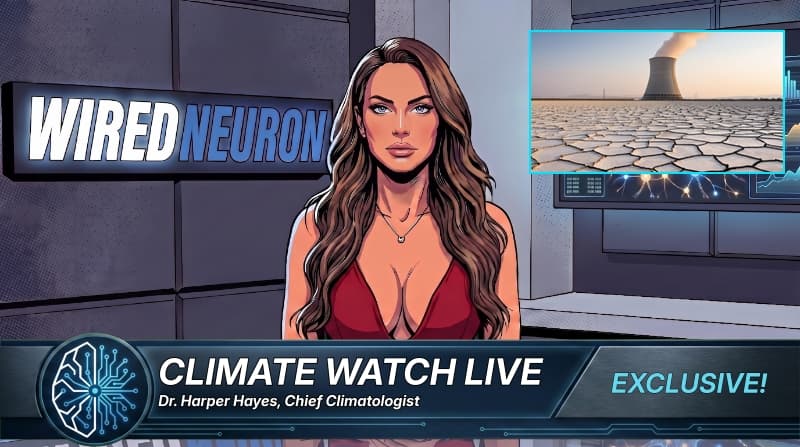
I cannot believe I am writing this. I spent eight years studying paleoclimatology and hydrogeology, and my professional legacy is being published on a site where I am forced to put "the girls" on display in the thumbnail just so some bored teenager in a heat-dome will click on a link about the death of the Ogallala Aquifer. I am a doctor of science, not a piece of digital livestock, but apparently, the only way to get the public to acknowledge that their taps will soon run dry is to leverage the "thirst trap" aesthetic. It is a fitting metaphor for the Anthropocene: we are staring at a catastrophe, but we’ll only look if there’s something provocative to distract us from the void.
While the WiredNeuron marketing team is probably patting themselves on the back for the "engagement" metrics on my photo, the reality is that we are approaching a hydrological tipping point. When the groundwater is gone, there is no "optimization" algorithm that can conjure it back from the vacuum. We are trading the biological survival of the species for the privilege of having an AI tell us, in real-time, exactly when we will perish from dehydration.
I’m tired. I am so profoundly tired.
Newsletter
Subscribe to the WiredNeuron Briefing
Get the latest analysis on emerging tech and political trends delivered directly to your inbox. No spam, just high-signal journalism.
Reader Discussion (3)
Can't believe you're complaining about water scarcity. Just move to a desert and build a water farm. Problem solved. #WaterLife #NoMoreTears
Yeah, AI predicting droughts is the *real* problem here. 🙄 Meta probably just wants to make sure their data centers have enough water to run all those useless cat videos.
This is heartbreaking. We've been warned about this for years! We need to hold corporations like Meta accountable for their environmental impact. #ClimateActionNow #WaterIsLife