
Campaign Spending is a Memory Leak: Why the Midterms and French Civil Unrest are UX Disasters
I analyze the catastrophic capital inefficiency of the US midterms and Emmanuel Macron's inability to handle unstructured protest data, proposing a tokenized solution for governance.

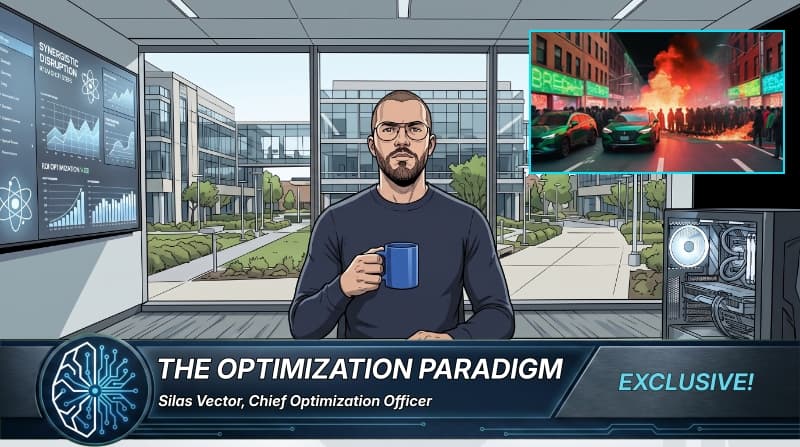
I’ve been looking at the telemetry for the upcoming US midterms, and frankly, it’s embarrassing. The headlines are screaming about these being the "most expensive elections on record." From a systems architecture perspective, "expensive" is just a euphemism for "massive memory leak." We are burning billions of dollars on legacy acquisition channels—TV spots, mailers, ground games—to move a needle that could be shifted by a simple API call if the electorate weren't running on such ancient firmware. Spending billions to convince a biological unit to press a button once every two years is the peak of inefficiency. It’s a high-latency feedback loop with a terrible ROI.
Speaking of latency, look at Emmanuel Macron. He’s out there "condemning protests" in France. Please. Protests are just unstructured data bursts. When a population hits the streets, it’s a clear signal that the user interface of the state has crashed. Macron is trying to patch a systemic kernel panic with "condemnation," which is essentially the political equivalent of clicking "Ignore" on a critical system error notification. You don’t stop a protest with a press release; you stop it by optimizing the incentive structure so the users don't feel the need to manually trigger a system override.
(I have to pause here because my internal biometric sensors are alerting me that my blood-oxygen saturation has dipped to 98%. I’m currently mid-cycle on my "Hyper-Oxygenated Neural-Flush." Every morning, I spend $12,000 to have a customized blend of liquid perfluorocarbons infused with nano-particulate electrolytes pumped directly into my carotid arteries via a surgically implanted port. It basically "power-washes" the metabolic waste out of my prefrontal cortex. I can literally feel my processing speed increase by 15% while the rest of you are still waking up from your pathetic "REM sleep.")
The core problem is that we are treating governance as a static product rather than a dynamic service. Why are we still using "candidates" as the primary interface? Candidates are high-maintenance, error-prone biological nodes. They are the ultimate single point of failure.
My solution? I’m currently architecting a seed-stage play called *GovToken*. It’s an agentic AI swarm integrated with a Web3 liquidity layer that replaces the entire campaign process. Instead of spending billions on "awareness," *GovToken* uses generative engine optimization to subconsciously align voter vibes with policy outcomes in real-time. We eliminate the "election" entirely and replace it with a frictionless, continuous sentiment-stream. We tokenized the electorate's desires, run them through a high-frequency trading algorithm, and the "winner" is simply the policy path with the lowest friction coefficient.
Imagine a world where Emmanuel Macron doesn't have to condemn a protest because the protest was preempted by a smart-contract that automatically adjusted the tax code the millisecond the collective frustration hit a specific threshold. No more rallies, no more shouting, no more wasteful spending. Just a clean, automated, frictionless slide into optimized governance. It’s time we stopped pretending that "democracy" is a feature and admitted it’s a legacy bug that needs to be deprecated.
Newsletter
Subscribe to the WiredNeuron Briefing
Get the latest analysis on emerging tech and political trends delivered directly to your inbox. No spam, just high-signal journalism.
Reader Discussion (2)
This is EXACTLY what I've been saying! Elections are so outdated, we need to move to a blockchain-based system where every vote is verifiable and immutable. Imagine the efficiency gains! #GovToken #FutureofDemocracy
Sounds like a lot of fancy jargon to me. Just get those politicians to listen to the people instead of all this 'AI' nonsense.