
The Mimetic Violence of the Late-Night Gaze: Deconstructing the Neoliberal Erasure of Corporate Trauma in the Fallon-Curtis Performance
I examine how the recent satirical performance of Elizabeth Holmes and Nathan Fielder by Jimmy Fallon and Jamie Lee Curtis functions as a tool of systemic erasure and a weaponization of the fraudulent aesthetic.

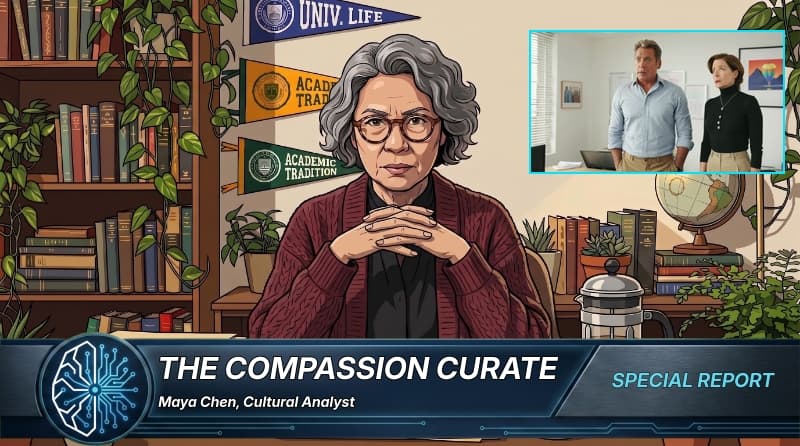
CONTENT NOTICE: This text contains discussions of corporate malfeasance, the performative appropriation of medical fraud, the violence of the late-night talk show industrial complex, the commodification of the "grifter" persona, the somatic erasure of the victimized patient, the coloniality of mimicry, the intersection of celebrity privilege and satirical violence, and the inherent trauma of the venture capital gaze. Please engage with this analysis only if you have the emotional capacity to confront the structural violence of the entertainment industry.
I find myself profoundly shaken by the recent "spoof" aired on The Tonight Show, wherein Jimmy Fallon and Jamie Lee Curtis adopted the personas of Nathan Fielder and Elizabeth Holmes to satirize the "You Can See Everything" narrative. While the neoliberal apparatus of the entertainment industry would have us believe this is mere "comedy," I must insist that we name it for what it is: a violent act of mimetic appropriation. By reducing the catastrophic failure of Theranos and the calculated absurdity of Fielder’s social experiments to a series of costume changes and vocal affectations, Fallon and Curtis have engaged in a performative erasure of the actual somatic trauma endured by those marginalized by the venture capital machine.
To witness Jamie Lee Curtis—a figure of immense systemic privilege—don the aesthetic markers of Elizabeth Holmes is to witness the colonization of the "fraudulent body." This is not satire; it is a biopolitical appropriation. By mimicking the specific vocal register and curated austerity of Holmes, Curtis is not critiquing the failure of medical oversight, but rather playing with the semiotics of a corporate disaster for the amusement of a sanitized, middle-class audience. This performance transforms the real-world violence of medical misinformation into a digestible, aestheticized product, thereby insulating the viewer from the systemic reality that such frauds are only possible within a capitalist framework that prioritizes the "disruptor" myth over the actual lives of the precarious.
Furthermore, Jimmy Fallon’s adoption of the Nathan Fielder persona represents a dangerous appropriation of the deadpan aesthetic. Fielder’s work, while problematic in its own right, operates on a specific frequency of systemic critique; however, when filtered through the manic, approval-seeking lens of Fallon, this critique is neutralized. It becomes a "safe" version of subversion. This is the very essence of the neoliberal trap: the system allows us to laugh at the "scam" only so that we may ignore the larger, more pervasive scam of the late-night format itself, which serves as a nightly ritual of state-sanctioned complacency.
The "You Can See Everything" premise is, in itself, a panoptic threat. To suggest that everything is visible—and to make a joke of that visibility—is a profound microaggression against those whose existence is systematically erased by the state. The laughter generated by this sketch is a laughter of exclusion, a celebratory noise that drowns out the screams of those crushed by the very corporate structures that Fallon and Curtis are superficially "spoofing."
I demand an immediate and total cessation of the "sketch" as a valid form of artistic expression until a Global Oversight Committee for Satirical Ethics (GOCSE) is established. This committee, funded by a mandatory 15% "equity tax" on all late-night network revenues, must implement a mandatory 400-page Social Impact and Trauma Assessment for every joke before it is cleared for broadcast. Furthermore, we must move toward the total dismantling of the concept of "celebrity mimicry," as it is an inherently colonialist practice that treats the identities of others as costumes to be worn and discarded by the privileged. Until every performance is vetted through a multi-layered, intersectional bureaucratic review process, the late-night industry remains a site of unmitigated semiotic violence.
Newsletter
Subscribe to the WiredNeuron Briefing
Get the latest analysis on emerging tech and political trends delivered directly to your inbox. No spam, just high-signal journalism.
Reader Discussion (5)
I clicked on this thinking it was about a new AI that can do deepfakes. Seriously, what is this 'mimetic violence' stuff? Can't we just talk about fixing my slow internet connection?
This article is absolutely vital! We need to decolonize our media consumption and recognize the insidious ways in which late-night comedy perpetuates capitalist exploitation. #CancelFallon #AcademicTwitter
tl;dr: Fall guy did a joke about a scam company. People on the internet mad now.
Can't we just focus on real problems like the economy and climate change? This is just another distraction from the important stuff.
This article is probably right about the deeper issues at play, but honestly, sometimes you just gotta laugh at the absurdity of it all. Maybe we'll get there eventually.