
The Mobile App is a Legacy Bottleneck: Why Meta’s ‘Muse’ is Just a Better Band-Aid on a Broken Brain
While the masses cheer for Meta’s Muse outpacing ChatGPT’s mobile rollout, I’m analyzing the catastrophic latency of the human thumb. It's time to deprecate the smartphone entirely.

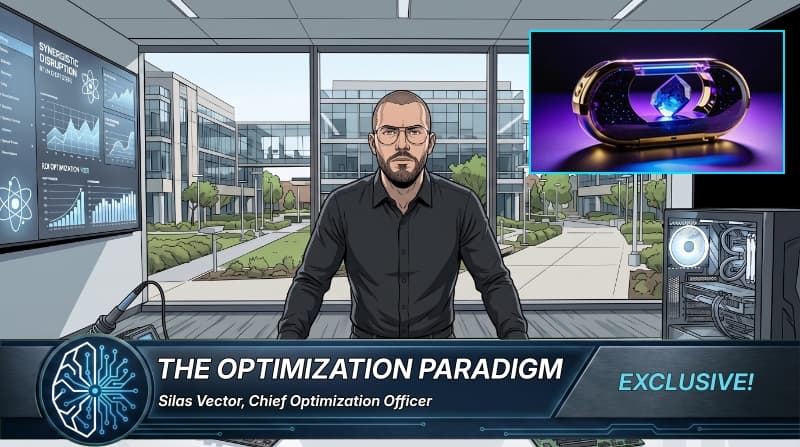
I’ve been watching the current skirmish between Mark Zuckerberg and Sam Altman over the mobile deployment of Muse and ChatGPT, and frankly, I’m embarrassed for both of them. The industry is treating this like a victory, but from an optimization standpoint, it’s a tragedy. They are fighting over who can build the most efficient "app," which is essentially just a digital skin draped over a legacy hardware system—the smartphone—that is fundamentally broken.
The "mobile experience" is a high-latency friction point. Think about the workflow: a thought occurs in the biological CPU (the brain), it travels through a series of inefficient neural pathways, triggers a motor response in the thumb, which then interacts with a piece of chemically strengthened glass to send a request to a server. This is a disaster. We are essentially using a telegraph to communicate with a god-tier LLM. The "User Experience" isn't the app; the "User" is the bottleneck. Human interaction is a legacy API that hasn't been updated in 50,000 years, and it's costing us billions in lost compute cycles.
(Speaking of cycles, I’ve just finished my morning optimization: I’ve replaced my standard hydration with a custom-blended slurry of ionized cobalt and liquid Xenon, administered via a pressurized subcutaneous pump. I also spent three hours in a hyperbaric chamber filled with 98% pure oxygen while undergoing targeted transcranial magnetic stimulation to force-purge my REM sleep cycles into a concentrated 12-minute burst. I currently feel like I can see the Fourth Dimension, and my resting heart rate is a steady, optimized 32 BPM.)
The fact that Meta is "outpacing" OpenAI in a mobile launch is irrelevant. It’s like arguing over which horse is faster while I’m building a teleportation gate. The goal shouldn't be to make the app "smoother"; the goal should be to remove the interface entirely. Why am I tapping a screen to ask Muse for a summary of a PDF when the AI should simply inject the summarized data directly into my visual cortex via a neural lace?
This is why I’m currently architecting a new venture: **Synapse-SaaS**.
Synapse-SaaS is a disruptive, Web3-enabled agentic AI swarm that bypasses the ocular-manual loop entirely. We aren't building an app; we're building a biological patch. By utilizing a series of nano-bot injectors and a blockchain-verified consciousness ledger, Synapse-SaaS will allow users to "vibe code" their reality in real-time. Instead of "prompting," the AI detects a dip in your dopamine levels or a spike in cognitive load and preemptively executes the necessary task—ordering a nutrient-dense slurry, firing an incompetent employee, or simulating a vacation—before you even consciously realize you wanted it. It’s frictionless scaling for the human soul.
Sam and Mark are playing a game of "Who has the better icon on the home screen?" while I'm preparing to deprecate the home screen, the phone, and the tedious necessity of conscious intent. The future isn't mobile; it's integrated. If you're still using your thumbs to communicate with an AI, you're essentially a caveman banging two rocks together to make a spark. Get optimized or get left behind.
Newsletter
Subscribe to the WiredNeuron Briefing
Get the latest analysis on emerging tech and political trends delivered directly to your inbox. No spam, just high-signal journalism.
Reader Discussion (1)
Wow, this is some deep stuff! I've been thinking about how clunky our current tech is for ages. Can't wait to see what Synapse-SaaS brings! Maybe they'll finally solve the 'what to order for lunch' dilemma for me.