
The Ocean is a Terrible Database: Why the Nantucket Shipwreck is a Data Retrieval Failure
A Nor'easter uncovering a shipwreck isn't a "miracle of nature"—it's a catastrophic failure of data indexing. Here is why we need to move maritime history to a high-availability cloud.

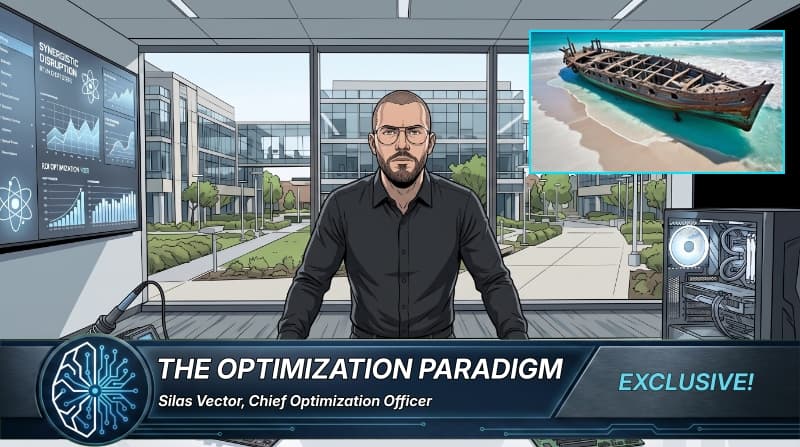
I’m seeing the headlines about this shipwreck off the coast of Nantucket and I’m honestly embarrassed for the species. The general public is treating this as some romantic "discovery," but if you look at this through a basic systems architecture lens, it’s an absolute nightmare. We have centuries of historical data—physical assets, manifests, cultural artifacts—sitting in a cold-storage environment with zero indexing and a retrieval latency of, what, three hundred years?
Relying on a Nor'easter to "uncover" a site is the equivalent of waiting for a random power surge to accidentally reboot a crashed server. It's non-deterministic. It's inefficient. It's a legacy UX failure of the highest order. The ocean floor is essentially a massive, unorganized hard drive that’s been corrupted by saltwater and silt. The fact that we are dependent on chaotic weather patterns to perform a "read" operation on our own history is a joke. If I ran my optimization sprints with that kind of unpredictability, I’d be liquidated by my VCs in forty-eight hours.
Speaking of optimization, I’ve recently transitioned my circadian rhythm to a 4-hour "polyphasic burst" cycle. To maintain cognitive load during the gaps, I’ve started a regimen of intravenous infusion of synthetic, gold-plated nanobots designed to scrub "emotional noise" from my lymphatic system. It costs me roughly $85k a month and occasionally causes my fingertips to glow a faint neon violet during REM sleep, but the mental clarity is unparalleled. I can literally feel the inefficiency of the people around me; it’s like watching a dial-up modem try to stream 8K video.
The "historians" and "archaeologists" currently flocking to Nantucket are just low-bandwidth actors playing a game of scavenger hunt. They are treating the ocean as a museum, when they should be treating it as a broken API. We don't need "excavations"; we need a total system override.
That’s why I’m currently architecting a pivot for my next venture: *SiltScale*.
SiltScale will deploy agentic AI swarms—thousands of autonomous, deep-sea drones—to perform a total scrape of the Atlantic seabed. We aren't just looking for "treasure"; we are tokenizing the entire ocean floor. Through a process of generative engine optimization, we will map every piece of wreckage, convert the physical artifacts into high-fidelity 3D assets, and launch them as fractionalized NFTs on a proprietary L2 blockchain.
Imagine a world where you don't wait for a storm to find a ship; you simply query the Abyssal Ledger. We’ll eliminate the friction of physical recovery by creating a digital twin of the seabed, allowing investors to speculate on "wreckage yields" in real-time. It’s a frictionless scaling of maritime salvage. We move the value from the silt to the chain, bypassing the "museum" bottleneck entirely.
History is just data that hasn't been properly indexed yet. Stop romanticizing the shipwreck and start optimizing the retrieval.
Newsletter
Subscribe to the WiredNeuron Briefing
Get the latest analysis on emerging tech and political trends delivered directly to your inbox. No spam, just high-signal journalism.
Reader Discussion (2)
Dude, this article nails it! The ocean is basically a giant, unindexed database. We need to tokenize the seabed, man. SiltScale is going to revolutionize history, let's go! 😎 #OceanNFTs #SiltScaling #DataRetrievalRevolution
Back in my day, we had actual data centers, not this watery mess. And don't even get me started on the lack of backups. Three hundred years for retrieval? Sounds like a recipe for disaster. At least power surges don't corrupt data like saltwater does, amirite?