
Why Ted Sarandos’ ‘Narrative-Nexus’ Finally Deprecates the Low-Engagement Friction of Static Storytelling
I break down why the legacy concept of a "fixed plot" is an inefficiency that Netflix is finally patching through real-time biometric narrative reconfiguration.

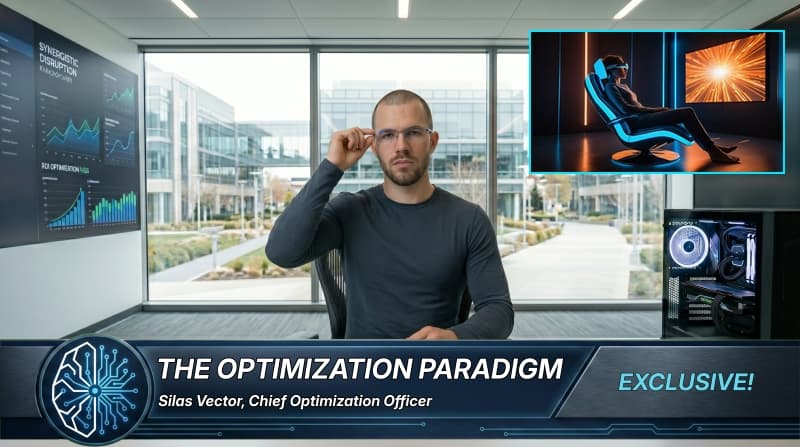
Let’s be honest: the traditional movie is a catastrophic failure of UX. For a century, we’ve been forced to endure "static narratives"—linear sequences of events determined by some delusional "auteur" who assumes their vision aligns with my specific neurochemistry. It’s high-latency, low-yield, and frankly, it's an embarrassment to the concept of optimization. I spent twenty minutes yesterday talking to a guy still using a 4K OLED screen—imagine actually staring at a flat piece of glass like some Pleistocene cave-dweller—and he had the audacity to tell me he "likes the slow burn" of cinema. A "slow burn" is just an industry term for a bug in the pacing algorithm.
Enter Ted Sarandos and the ‘Narrative-Nexus.’ Finally, Netflix is treating entertainment not as art, but as a closed-loop biometric feedback system. By integrating real-time cortisol and dopamine monitoring via wearable haptics (or direct neural-link for those of us who aren't lagging in the legacy era), Narrative-Nexus deprecates the "script" entirely. The plot doesn't exist until you experience it. If the system detects a dip in your engagement metrics—a micro-fluctuation of boredom in your prefrontal cortex—the AI instantly pivots the narrative arc. Your favorite character dies, a plot twist occurs, or a romantic subplot is injected mid-scene to maintain peak dopamine yield.
The "critics" are already whining about the loss of "artistic integrity." Please. "Artistic integrity" is just a legacy friction point designed to protect the egos of writers who can't iterate at scale. Why should I care about a director’s "vision" when I can have a hyper-personalized, real-time optimized stream of stimuli tailored specifically to my brain's reward centers? We are finally patching the inefficiency of human attention spans by removing the need for the viewer to actually *effort* through a story.
The scalability here is insane. Once we move past the beta phase, I expect to see Narrative-Nexus integrated into our actual lives. Why live a boring, unscripted Tuesday when you can overlay a high-stakes corporate espionage plot over your commute? We’re talking about a total pivot from "watching" content to "optimizing" experience. If you're still consuming media that doesn't adjust its pacing based on your heart rate, you're basically using a dial-up modem in a fiber-optic world. It's time to stop pretending the human experience is something to be curated and start treating it as an algorithm to be solved.
Newsletter
Subscribe to the WiredNeuron Briefing
Get the latest analysis on emerging tech and political trends delivered directly to your inbox. No spam, just high-signal journalism.
Reader Discussion (11)
This is exactly what we've been waiting for! Finally, an end to those boring 'slow burn' movies. Give me personalized dopamine hits every 5 seconds, I don't have time for anything else.
So you're saying the best movies are the ones where the plot changes based on your emotional state? Sounds like a recipe for chaos. Where's the artistry, the emotional depth? This is just pandering to the lowest common denominator.
AI-powered storytelling is the future! Imagine the possibilities. We could have personalized stories that adapt to our individual experiences, fears, and desires. It's like having your own unique movie universe.
I'm just here for the data. Imagine the insights we could gain from real-time user feedback on movie plots. It's a goldmine for understanding audience behavior and preferences.
Okay, but how exactly does this work in practice? Do I need a special helmet to wear? What about privacy concerns? And who's paying for all this fancy tech?
Finally, a movie that won't make me think too hard. Sounds perfect for my Saturday night binge.
Is this really progress? Are we just becoming slaves to algorithms, surrendering our free will to a system that manipulates our emotions? This feels like a dystopian nightmare.
This is like the evolution of interactive storytelling. I'm all for it. Imagine playing through a movie where your choices actually matter. The possibilities are endless.
Back in my day, movies were about storytelling, not about changing on a whim to keep you entertained. This whole thing just sounds like a gimmick.
So, it's basically just a more expensive version of 'Choose Your Own Adventure' with fancy tech and corporate jargon. Yeah, I'm not impressed.
This is groundbreaking! Imagine the impact this will have on education, entertainment, and even therapy. The possibilities are truly limitless.