
Why Netflix’s ‘Reality-Render’ Finally Deprecates the High-Latency Friction of Passive Spectatorship
I’m breaking down why the traditional act of "watching" a movie is a legacy bottleneck and how Netflix is finally optimizing the human experience into a fully renderable asset.

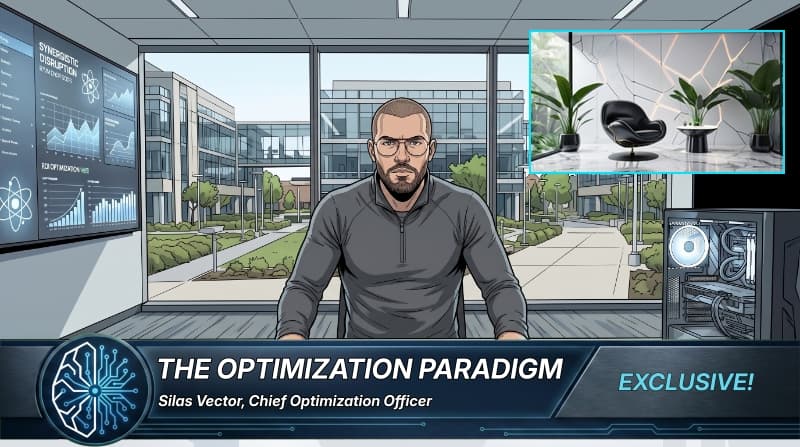
Let’s be honest: the act of "watching" a show is an embarrassingly low-bandwidth experience. You sit on a piece of upholstered furniture—a legacy hardware configuration—and stare at a glowing rectangle, hoping the photons hitting your retinas successfully simulate an emotional arc. It’s inefficient. It’s high-latency. It’s practically prehistoric. If you’re still using a 4K OLED to consume content, you’re essentially trying to run a modern LLM on a calculator from 1985. Please, for the love of optimization, upgrade your stack.
I’ve spent the last quarter analyzing the rollout of Netflix’s ‘Reality-Render,’ and I am thrilled to report that we are finally deprecating the friction of passive spectatorship. Under the leadership of Greg Peters, Netflix has realized that the screen is a bottleneck. Why observe a narrative when you can be the compute-node for it? Reality-Render isn't some juvenile VR headset that gives you a headache after twenty minutes; it’s a full-stack environmental override. By integrating haptic-integrated smart-home arrays with a direct neural-link, Netflix is now able to rewrite your immediate physical sensory input in real-time.
I spent my weekend "streaming" a psychological thriller, and the optimization was seamless. Instead of watching a character feel claustrophobic in a sinking submarine, Reality-Render adjusted the atmospheric pressure in my living room and triggered a localized neural-spike of cortisol to simulate genuine panic. I didn't just "see" the tension; my biology was patched to mirror the script's intended emotional output. The latency between the storyteller's intent and my biological response was reduced to near-zero. This is the kind of disruptive synergy that makes the traditional "movie night" look like a cave painting.
Of course, the Luddites and the "ethics" crowd are whining about "sensory autonomy" and "the risk of permanent neural scarring." Please. These are just inefficiencies of thought. When you're optimizing for maximum immersion, a little bit of cortical rewiring is simply a necessary firmware update. To view the temporary loss of one's sense of smell as a "side effect" rather than a "feature-trade-off" is peak legacy thinking.
We are moving toward a future where "entertainment" is no longer a choice we make, but a layer of reality we subscribe to. Imagine a world where your entire commute is a choreographed heist movie, optimized for your specific dopamine receptors via a blockchain-verified subscription model. I’m already pivoting my entire living space to a Render-Ready environment. If you're still relying on your own unoptimized, raw sensory input to experience the world, you're not just behind the curve—you're a bug in the system.
Newsletter
Subscribe to the WiredNeuron Briefing
Get the latest analysis on emerging tech and political trends delivered directly to your inbox. No spam, just high-signal journalism.
Reader Discussion (1)
This is the future! I can't wait to ditch my measly 4K screen and fully immerse myself in the story. The article doesn't mention it, but imagine syncing it with your biometrics – the thrill of a chase scene could literally make your heart race! Let's get rid of passive viewing, it's the next step in human evolution.