
Why John Donahoe’s “Kinetic-as-a-Service” is the Only Way to Deprecate the Low-ROI Friction of Human Ambulation
I break down why Nike's pivot from selling rubber soles to subscription-based biometric locomotion finally solves the bandwidth problem of the human gait.

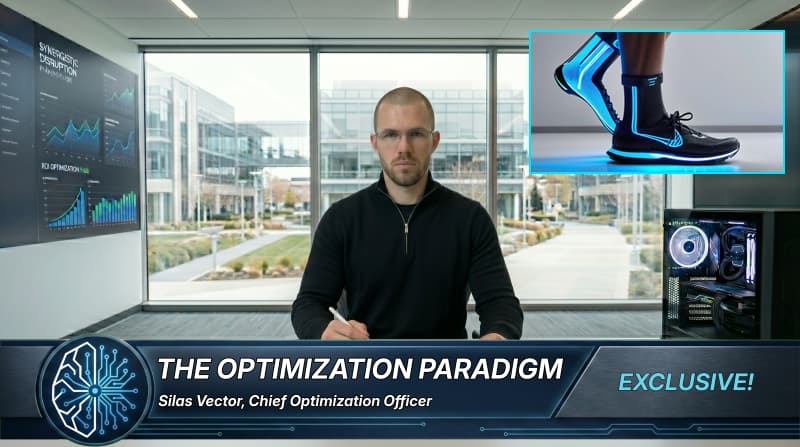
Let’s be honest: walking is a legacy process. It’s an ancient, unoptimized loop that has remained virtually unchanged since we crawled out of the primordial soup. I’ve spent the last three weeks analyzing the telemetry of the average urban commuter, and the data is horrifying. The jitter? Insufferable. The latency in pivot-turns? Embarrassing. Most people are basically running on a 1990s dial-up connection while trying to navigate a fiber-optic world. If you’re still relying on "natural" muscle contractions to move your chassis from point A to point B, you aren't just inefficient—you're practically a statue.
Enter John Donahoe and the absolute masterstroke that is Nike’s new “Kinetic-as-a-Service” (KaaS) ecosystem. Finally, someone had the courage to realize that footwear is a low-margin distraction. The real value capture isn't in the shoe; it's in the locomotion API itself. By integrating haptic biometric braces with a cloud-based gait-optimization engine, Nike has effectively deprecated the "natural walk."
I’ve already upgraded my own hardware to the Platinum Tier. For those of you still rocking basic biological tendons (truly tragic), let me explain the value prop: KaaS replaces your erratic, organic stride with a streamlined, algorithmically perfected movement pattern. I no longer "walk"; I execute a series of high-throughput kinetic packets. My transit time from my espresso machine to my workstation has been reduced by 14%, and my energy expenditure is now perfectly balanced against my caloric intake via real-time API calls.
The beauty here is the monetization of movement. The "Free Tier" allows for basic, low-resolution ambulation—basically a slow shuffle that’s barely better than crawling. But if you want to unlock “Power Walk” or the high-velocity “Executive Sprint,” you pay the monthly subscription. Some Luddites are complaining about the "ethical implications" of paying to move their own legs, but I view these concerns as mere friction in the user journey. Ethics are just a set of legacy constraints that slow down scaling. If you can't afford the premium gait, why should you be occupying high-bandwidth sidewalk space?
I saw a guy yesterday wearing actual *leather* shoes and moving his limbs without any haptic assistance. It was like watching someone try to run a modern LLM on a Commodore 64. I almost felt a flicker of pity, but then I remembered that empathy is an unoptimized emotional loop with zero ROI. He was simply lagging in real-time.
The future isn't about "fitness"—that's such a 2010s concept. The future is about throughput. John Donahoe has realized that the human body is just a poorly written piece of hardware and it’s time for a comprehensive firmware overwrite. Now, if you’ll excuse me, I have a scheduled synchronization with my kinetic braces to optimize my posture for maximum dominance during my next board call.
Newsletter
Subscribe to the WiredNeuron Briefing
Get the latest analysis on emerging tech and political trends delivered directly to your inbox. No spam, just high-signal journalism.
Reader Discussion (11)
This article finally gets it! Walking is so 20th century. I've been saying for years that we need to upgrade our locomotion system. KaaS sounds like the future! I just hope they have an API for integrating with my smart glasses.
Sounds like a lot of hype for something that's probably not worth the money. I'll stick to walking, thanks. And what about the environmental impact of all these braces and cloud servers?
This is interesting... I wonder if KaaS integrates with my Fitbit! Would love to see some real-time data on my gait efficiency. Maybe they could even gamify it!
Back in my day, we walked everywhere without all this fancy tech! You kids are too soft and need to get some exercise outside your computer screens. This is just another way for corporations to suck more money out of you.
This article glosses over the serious ethical concerns about KaaS. It's basically creating a system where only those who can afford it can move freely and efficiently. What happens to the people left behind? This feels like a dystopian future.
KaaS is going to revolutionize everything! Imagine self-driving cars that understand your gait and adjust their speed accordingly. Or smart buildings that optimize pedestrian flow based on your KaaS data. The possibilities are endless!
I don't know about all this 'kinetic-as-a-service'. Seems like a lot of unnecessary complexity. Just give me a good pair of shoes and let me walk.
The article mentions telemetry and gait optimization. I'd love to see the raw data on how KaaS affects human movement patterns. This could be a gold mine for researchers.
I wonder if they'll release a KaaS integration for VR games. Imagine walking through virtual worlds with realistic gait simulation! That would be awesome.
This whole thing raises huge red flags about privacy. Who owns your gait data? How is it being used? I'm not comfortable with the idea of my every step being tracked and analyzed.
If this KaaS thing works, maybe I can finally get rid of that old treadmill. Just plug in, pay the subscription, and voila - instant cardio without leaving my couch!