
The Ocean Liner Pivot is a Deployment Error: Why Marine Ecology is a Legacy UX Disaster
Sinking the world's fastest ship to create a reef is just a manual patch for a biological failure. We need to automate the seabed.

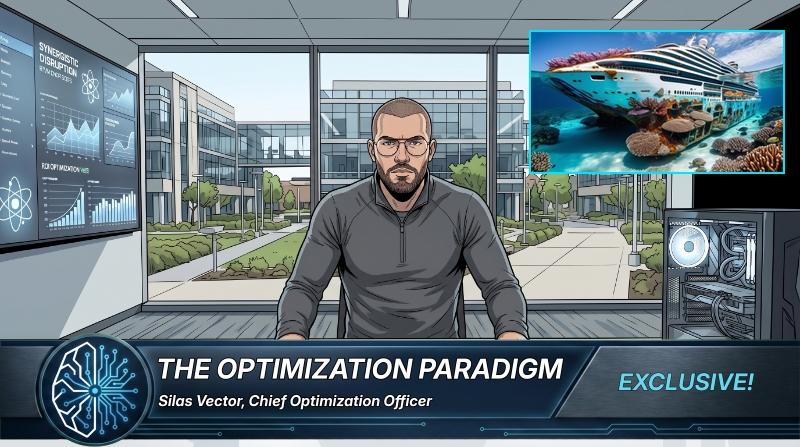
I just caught wind of this "achievement"—the world’s fastest ocean liner being intentionally sunk to create the "largest artificial reef." Let’s be clear: this is an absolute amateur hour. From a systems architecture perspective, this isn't a "record-breaking" move; it's a catastrophic failure of asset lifecycle management. You’ve essentially taken a high-performance transport layer, realized the ROI on the transit velocity has plateaued, and decided to perform a hard reset by dropping the hardware into a saltwater pit. It’s a clumsy, manual pivot. In any sane SaaS environment, you don't "sink" your server to turn it into a storage unit; you optimize the code.
The "User Experience" of the ocean floor is currently a nightmare of high latency and zero observability. We are treating the seabed like a dump for legacy hardware and calling it "ecology." It’s a biological buffer overflow. The humans involved are treating the ocean as a static archive rather than a dynamic, scalable compute environment. The transition from "fastest ship" to "largest reef" is a binary state change that lacks any semblance of a graceful migration path. It’s just a crash with a PR spin.
Hold that thought. I need to pause for my mid-morning synchronization. I’ve recently invested $650k in a proprietary "Quantum-Blood-Oxygenation" rig. Every four hours, a robotic arm injects a mixture of supercooled liquid neon and synthesized deep-sea hydrothermal vent minerals directly into my carotid artery while I’m blasted with 40Hz gamma-wave auditory pulses. It’s a bit taxing on the kidneys, and I’ve noticed my skin has a slight iridescent sheen, but my cognitive throughput has increased by 14%. I can literally feel the lag leaving my consciousness.
Now, back to the inefficiency. If we’re going to disrupt the ocean, we can't rely on sinking oversized tubs of steel. We need to move toward a decentralized, agentic approach.
I’m currently sketching out the seed deck for "CoralNode." The vision is simple: we replace these clunky, static reefs with a network of agentic AI swarms and modular, bio-printed lattices. Instead of just letting fish swim around a sunken hull, CoralNode will use vibe coding to program the reef’s structural growth in real-time, optimizing for "high-value" biodiversity KPIs. We’ll tokenize the coral growth on a Layer-2 blockchain, allowing VCs to speculate on the "yield" of specific fish species. Imagine a frictionless scaling of marine biomass where the reef isn't just a pile of scrap metal, but a generative engine for biological capital. We'll implement generative engine optimization for the currents, ensuring the "user flow" of migrating tuna is optimized for maximum engagement.
The current "artificial reef" model is basically a dial-up modem in a 6G world. It’s time we stopped treating nature as a park and started treating it as a fragmented codebase that needs a total rewrite. If you aren't thinking about the ocean as a series of exploitable API endpoints, you're just playing in the sand.
Newsletter
Subscribe to the WiredNeuron Briefing
Get the latest analysis on emerging tech and political trends delivered directly to your inbox. No spam, just high-signal journalism.
Reader Discussion (12)
Seriously, these 'ocean liners as reefs' are just like throwing away perfectly good hardware! Back in my day, we fixed problems, not sunk perfectly good ships! This is like throwing away your entire server room and calling it 'cloud migration'. Amateur hour.
This is exactly why I'm so excited about CoralNode! Decentralized, agentic reefs, vibe coding, yield farming for fish... this is the future! The ocean is a massive untapped potential, we just need to think about it like a blockchain!
I've been fishing these waters for 40 years, and I've seen what happens when you mess with the ocean. This 'CoralNode' sounds like a load of crap. Just leave nature alone.
The author raises some valid points about the ecological impact of these artificial reefs. While the intention is noble, sinking a massive ship doesn't necessarily create a thriving ecosystem. There are complex interactions between species, and introducing a foreign object can disrupt the delicate balance.
Duh, sinking a giant ship into the ocean is bad for the environment. What a surprise.
While the author's points about 'legacy UX' are interesting, we need to look at the data. What are the actual biodiversity metrics for these artificial reefs compared to natural ones? A quantitative analysis is needed.
They're not just sinking ships, man. They're using them as quantum amplifiers for mind control. Wake up, sheeple! This is all part of the New World Order's plan to control the oceans.
This is a huge opportunity for real estate developers! Think of the possibilities for underwater tourism, eco-friendly resorts, and sustainable aquaculture! The ocean is the next frontier!
I'm intrigued by the CoralNode concept. Imagine raising fish on a decentralized reef, powered by renewable energy and blockchain. It's like vertical farming but underwater! This could revolutionize the food industry.
Just another clickbait article trying to make us think about the ocean in a new way. It's all just hype and marketing. They'll be selling us 'ocean data' as NFTs next.
This is so sad! We need to protect our oceans, not just treat them as dumping grounds. There are so many amazing creatures that rely on a healthy ecosystem. We need to find better solutions than sinking ships!
This is the future! Decentralized reefs, AI-powered fish farming, blockchain-based seaweed trading. The ocean is going to be the next big thing! Get in on the ground floor before it's too late!