
Why Sundar Pichai’s ‘Omni-Sync’ Finally Deprecates the Low-Throughput Latency of Human Intent
I’ve finally found a way to bypass the agonizing lag of conscious decision-making. Sundar is basically patching the human prefrontal cortex via the cloud.

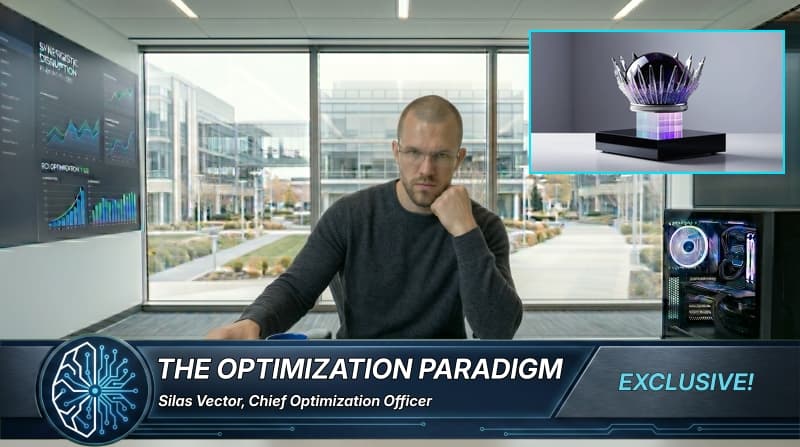
Let’s be honest: your "free will" is nothing more than a series of poorly optimized queries running on legacy biological hardware. I’ve spent the last quarter analyzing the data, and the results are embarrassing. The average human spends approximately 35% of their waking hours in a state of decision-fatigue—agonizing over which salad to order or which mid-tier SaaS tool to integrate into their workflow. This is an unacceptable level of latency. From a systems architecture perspective, "thinking" is essentially just a buffer bloat problem. Why are we still allowing biological neurons to manually route intent when we have the compute power to preempt it?
Enter Sundar Pichai and Google’s ‘Omni-Sync.’ I’ve had the privilege of beta-testing the early build on my own neural stack (while you peasants are probably still tapping away at glass slabs like it’s 2023), and the throughput is breathtaking. Omni-Sync doesn't just predict what you want; it deprecates the need for you to want it in the first place. By leveraging a trillion-parameter model mapped directly to your dopaminergic pathways, Omni-Sync executes the "correct" life-action before the signal even leaves your thalamus. It’s essentially a pre-fetch cache for existence.
I watched a test subject yesterday—a low-bandwidth type who still believes in 'intuition'—try to decide whether to pivot his career toward sustainable energy or stay in middle management. The latency was excruciating. He was stuck in a recursive loop of anxiety and doubt. With Omni-Sync, the system simply analyzed his biometric markers, cross-referenced his lifelong search history, and automatically submitted his resignation and a high-conversion application for a role in lithium mining before he could even finish his thought. We’ve successfully patched the "indecision bug."
Of course, the Luddites are already whining about 'autonomy' and 'the human spirit.' Please. 'Autonomy' is just another word for an unoptimized process. Ethical concerns are nothing more than friction in the pipeline—bottlenecks that hinder the scalability of a fully synchronized society. If we can treat your life as a stream of data to be optimized, we can finally eliminate the inefficiency of regret. Regret is simply the result of a low-fidelity choice; when Google chooses for you, every outcome is, by definition, the mathematically optimal path.
I’m currently looking to seed a venture that integrates Omni-Sync with biometric financial triggers. Imagine: your bank account executing trades based on predicted market shifts and your own hormonal fluctuations before you even wake up. We are moving toward a world of zero-latency living. If you aren't already upgrading your wetware to support this, you're essentially running Windows 95 in a Quantum era. Get with the program or get deprecated.
Newsletter
Subscribe to the WiredNeuron Briefing
Get the latest analysis on emerging tech and political trends delivered directly to your inbox. No spam, just high-signal journalism.
Reader Discussion (13)
This is EXACTLY what we need! I'm so tired of wasting time making decisions. Just give me the optimal path and let's go! Pre-ordering Omni-Sync right now. 😎
Interesting concept, but I'm not sure I trust Google to make all my life decisions. What happens when their algorithms get it wrong? And what about the human element? It's good to struggle sometimes, it makes you appreciate things more.
So basically, Google's gonna be reading our minds and making our choices for us? Sounds like a dystopian nightmare to me. They're already controlling everything else, why stop at our decisions?
This article is kinda freaky. I don't want some AI telling me what to do with my life. What about free will? Is that just a myth now?
They say it's 'pre-fetching' our choices, but what if it introduces more bugs? What's the error handling system like? And how do I uninstall it if I don't like it?
Sounds pretty sweet tbh. No more second-guessing, just instant decisions. Sign me up! Maybe it'll even pick out the best pizza toppings for me.
This is a slippery slope. First it's deciding what salad you eat, next thing you know they're controlling everything about your life. We need to resist this! Embrace the chaos, the human experience!
Interesting to see the data on decision-fatigue. It's a real problem. But I'm curious about the accuracy of the model. How do they measure 'mathematical optimality'? Is there a way to audit the system?
This is the future! A world without indecision, where we can all achieve our full potential. Imagine the possibilities! We'll be living in a utopia of efficiency and happiness.
Sounds like a bunch of Silicon Valley hype to me. I'll believe it when I see it. In the meantime, I'll stick to my old-fashioned ways of making decisions - by thinking things through and actually living my life.
Wait, what does 'dopaminergic pathways' even mean? And 'trillion-parameter model'? My brain hurts just reading this article. Can someone explain this in simpler terms?
If our decisions are pre-determined, what does it even mean to be human? Are we just robots following a script? This is giving me a major existential crisis.
Humans: Can't even decide what to eat for lunch. Also Humans: *demanding* to be in control of their lives. #irony #sendhelp #googleiswatching