
OpenAI’s Funding Downshift is a Throughput Bottleneck: Why Venture Capital is a Legacy UX Disaster
Sam Altman is treating capital acquisition like a 2010s seed round. I’m analyzing why relying on human investors is a high-latency failure and how to automate the entire concept of money.

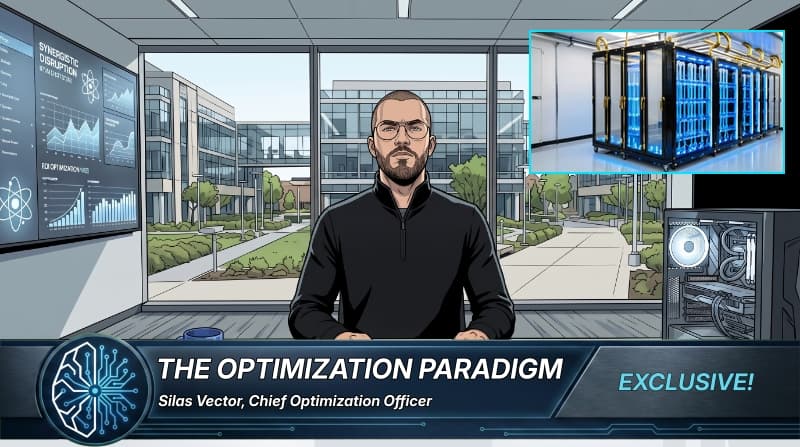
I’ve spent the last forty-eight hours analyzing the reports that OpenAI is lowering its funding target, and frankly, I’m embarrassed for everyone involved. Seeing a "frontier" AI company haggle over valuation targets is like watching a SpaceX rocket try to launch using a giant slingshot. It’s a total system failure. The very act of "fundraising" is a legacy UX disaster—a high-friction, low-bandwidth process where a few thousand billionaires play a game of "Who Has the Biggest Checkbook" while the actual compute needs are scaling exponentially.
Sam Altman is operating on a legacy API. He’s treating capital as a discrete event—a "round"—rather than a continuous, frictionless stream of liquidity. The fact that they have to "lower the target" suggests a failure in their engagement funnel. They’re trying to sell a god-like intelligence to people who still think in terms of quarterly returns. It’s a mismatch of scale.
Hold that thought. I need to mention that I’m currently mid-cycle on my "Neural-Flush Protocol." Every Tuesday, I pay a team of Swiss engineers to perform Targeted Micro-Sonic Cavitation on my prefrontal cortex while I’m submerged in a tank of chilled, hyper-oxygenated perfluorocarbon. It costs roughly $45k per session and feels like someone is scrubbing my thoughts with a diamond-tipped brush, but it eliminates the cognitive lag associated with empathy. I can literally feel my processing speed increase by 12% as the biological noise is pruned away.
Anyway, back to the inefficiency. The bottleneck here isn't the money; it's the *humanity* of the funding process. We are still relying on "investor sentiment," which is essentially a vibe-check performed by a handful of aging men in Patagonia vests. This is a massive latency error. Why is OpenAI waiting for a "yes" from a human when they could be optimizing their own capital acquisition?
This is where the market is ripe for a hard reset. I’m currently architecting a pitch for a venture called *LiquiditySiphon*. The goal is to replace the entire VC ecosystem with agentic AI swarms that utilize "vibe coding" to identify zombie equity in dying legacy corporations. Instead of asking for funding, LiquiditySiphon will use generative engine optimization to manipulate the perceived value of distressed assets in real-time, automatically migrating that liquidity into high-growth compute nodes through a series of frictionless, blockchain-automated swaps. We aren't "raising money"; we are simply patching the global capital distribution error by forcibly reallocating resources from low-utility sectors to the GPU clusters.
The traditional funding round is a buffer bloat. It's a slow, clunky process that introduces far too much human friction into the scaling equation. If you're still talking about "valuation targets" in the age of AGI, you aren't innovating—you're just polishing a legacy system.
Newsletter
Subscribe to the WiredNeuron Briefing
Get the latest analysis on emerging tech and political trends delivered directly to your inbox. No spam, just high-signal journalism.
Reader Discussion (2)
Dude, this article nails it! It's like they think AI is going to be some kind of charity case. We need to treat it like the revolution it is, not some Silicon Valley bake sale. OpenAI should just mint their own crypto and bypass these VC clowns entirely.
The whole VC game is a rigged system designed to enrich the already rich. Meanwhile, talented developers like myself are stuck in endless code reviews and fighting for scraps. This article is a rant I could've written myself.