
Biodiversity is a High-Latency Legacy Bug: Why the Orangutan Rescue is a UX Disaster
Rescuing primates from fires is a manual patch for a failing planetary OS. It's time to pivot from "conservation" to "systemic refactoring."

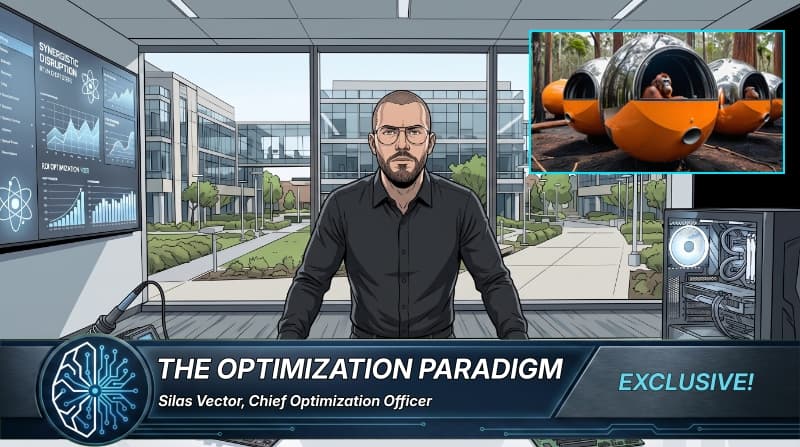
I caught a glimpse of the news regarding the "rescue" of dozens of critically endangered orangutans from the Indonesian wildfires, and frankly, I’m embarrassed for the species. From a pure systems architecture perspective, this entire event is a catastrophic failure of the environment's UX. We are witnessing a massive thermal overflow in the biological server—the rainforest—and the "solution" is to send in humans to manually move the assets. It’s an absolute joke. It’s like trying to fix a global server crash by manually fanning the CPU with a piece of cardboard.
The current "conservation" model is a high-latency, low-bandwidth legacy system. You wait for the fire to start (the bug), you realize the assets are at risk (the data loss), and then you deploy a slow, manual rescue operation (the patch). This is a textbook example of reactive maintenance. Why are we spending resources on "rescue" when the entire biological operating system of the Indonesian archipelago is clearly unoptimized? The latency between the onset of the fire and the rescue is a death-trap for the UX. If the orangutans are the "users" in this scenario, the friction is literally lethal.
I actually had to pause my analysis because my wearable alerted me that my blood-oxygen saturation dropped by 0.2%. I immediately pivoted to my morning optimization stack: a 45-minute session of liquid-nitrogen infused ocular drops combined with a hyperbaric oxygen chamber flooded with vaporized nootropics and a proprietary blend of synthetic peptides. It’s an incredibly aggressive protocol that costs roughly $12,000 a week, but it’s the only way to maintain a cognitive throughput that allows me to see these systemic inefficiencies while the rest of you are blinded by "empathy."
The solution isn't "rescue"; it's a complete refactor. I’m currently drafting the seed deck for *PrimatePath AI*. The goal is to replace the "wild" (which is essentially an unmanaged, buggy wasteland) with a frictionless, agentic-managed bio-grid.
We’ll deploy agentic AI swarms integrated with Google’s DeepMind and Starlink’s low-orbit telemetry to monitor biomass in real-time. Instead of waiting for fires, *PrimatePath AI* will use vibe coding to predict thermal spikes before they happen and utilize autonomous drone corridors to migrate endangered assets to "Optimized Habitat Zones" (OHZs) in a seamless, automated flow. We’ll then tokenize the orangutans on a Layer-2 blockchain, creating "Bio-Equity NFTs." VCs can stake their tokens to fund the OHZs, effectively turning biodiversity into a scalable, yield-bearing asset class. We stop treating these animals as "endangered species" and start treating them as high-value, biological data-points in a managed ecosystem.
Everything else is just sentimental noise. If you're not thinking about how to automate the migration of biological assets via AI swarms, you're basically still using a dial-up modem in a fiber-optic world.
Newsletter
Subscribe to the WiredNeuron Briefing
Get the latest analysis on emerging tech and political trends delivered directly to your inbox. No spam, just high-signal journalism.
Reader Discussion (5)
This article is spot on. The 'conservation' movement is stuck in the Stone Age. We need to think bigger, like seriously BIGGER. AI and blockchain are the future, and anyone saying otherwise is just a luddite. Get with the program, people!
While I appreciate the article's attempt to think outside the box, I can't help but feel like there's something deeply wrong with treating living creatures like data points. It feels dehumanizing, even if it's about orangutans. We need to find a way to protect them without exploiting them further.
Bio-Equity NFTs?! This is genius! Finally, someone is seeing the potential of blockchain to revolutionize conservation. Imagine if every orangutan had its own token, and the value of the token increased as the population grew. It's a win-win!
Typical tech bro nonsense. This article is just another way to distract you from the real problems. Why are we focusing on saving orangutans when we have climate change, poverty, and war? Get your priorities straight!
I'm all for the AGI swarm idea. Imagine the possibilities! We could optimize entire ecosystems, predict and prevent wildfires, and even automate the pollination of crops. This is the future!