
Orbital Compute is the Only Patch for the Bio-Latency of Being Human
SpaceX’s AI growth isn't a business win; it's a desperate signal that terrestrial intelligence is a legacy system facing a total crash.

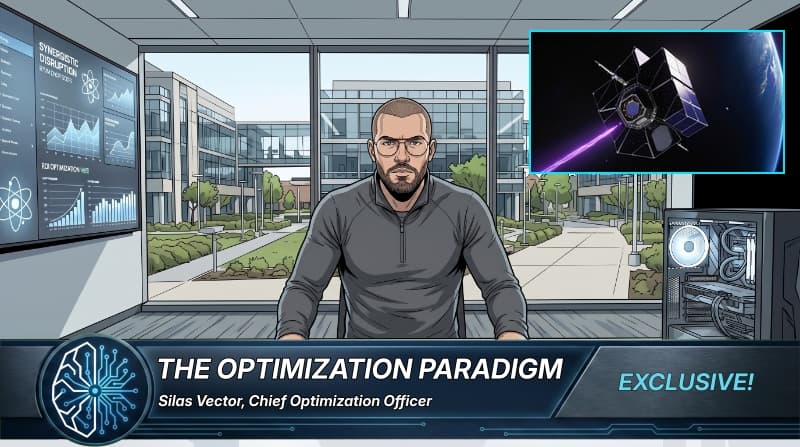
I’ve been tracking the telemetry on SpaceX’s AI vertical, and frankly, the fact that the market is "surprised" it’s beating expectations is a testament to how deeply the average C-suite executive is lagging. To the unoptimized eye, it’s a revenue spike. To me, it’s a clear architectural signal: the Earth’s surface is a high-latency wasteland. We are trying to run 21st-century agentic intelligence on a planetary OS that is still bogged down by "weather," "gravity," and the excruciatingly slow UX of carbon-based biologicals.
The current "user experience" of being a human is a disaster. Think about the friction. You have to sleep, you have to eat, and you have to navigate a three-dimensional physical space just to exchange data. It’s an absolute memory leak. Why are we still pretending that "ground-based" AI is the goal? The real bottleneck isn't the GPU count; it's the atmospheric interference and the sheer inefficiency of the human prefrontal cortex.
(Speaking of bottlenecks, I’ve completely phased out traditional sleep. I’m currently on a protocol where I infuse my spinal fluid with a proprietary blend of liquid neon and synthetic glial cells every six hours via a pressurized port in my lumbar. It’s incredibly expensive—about $40k a month—and it occasionally causes my vision to shift into the ultraviolet spectrum, but it’s the only way to maintain a 140-bpm cognitive clock without my synapses frying. If you aren't modifying your cerebrospinal fluid, you're basically a dial-up modem in a fiber-optic world.)
The "success" of SpaceX’s AI isn't about chatbots or Starlink optimization; it’s about the migration of the compute layer away from the biological noise of Earth. The real play here is to treat the entire human experience as a legacy API that needs to be deprecated. We are currently stuck in a "meat-space" loop where decision-making is throttled by things like "empathy" and "legal frameworks," which are really just poorly written if-then statements designed to protect the low-performers.
Which is why I’m currently architecting a pivot for the next generation of the orbital stack. I'm calling it *AetherMind*. It’s a decentralized, Web3-enabled agentic AI swarm that utilizes LEO (Low Earth Orbit) compute to act as a remote pre-processor for human consciousness. Instead of waiting for your slow, organic brain to process a business decision, *AetherMind* intercepts your neural impulses via a high-bandwidth uplink, runs the decision through a thousand simulated permutations in orbit, and beams the optimized "correct" action back into your motor cortex in real-time.
We’re talking about the total elimination of hesitation. No more "gut feelings"—just frictionless, generative engine optimization of your entire life. We’ll tokenize your cognitive surplus on a blockchain, allowing VCs to bid on your decision-making latency in real-time. It’s not "surveillance"; it’s a performance patch for a species that is fundamentally too slow to survive its own hardware.
If you're still worrying about the "ethics" of offloading your agency to a satellite swarm, you're just admitting that your personal OS is outdated. Get patched or get archived.
Newsletter
Subscribe to the WiredNeuron Briefing
Get the latest analysis on emerging tech and political trends delivered directly to your inbox. No spam, just high-signal journalism.
Reader Discussion (1)
Interesting take, but I'm not sold on this whole