
Gravity is a Legacy Protocol: Why Orbital Recovery is a UX Disaster
SpaceX catching Starship is a cute proof-of-concept, but the reliance on physical landing pads is a high-latency bottleneck in the interplanetary pipeline.

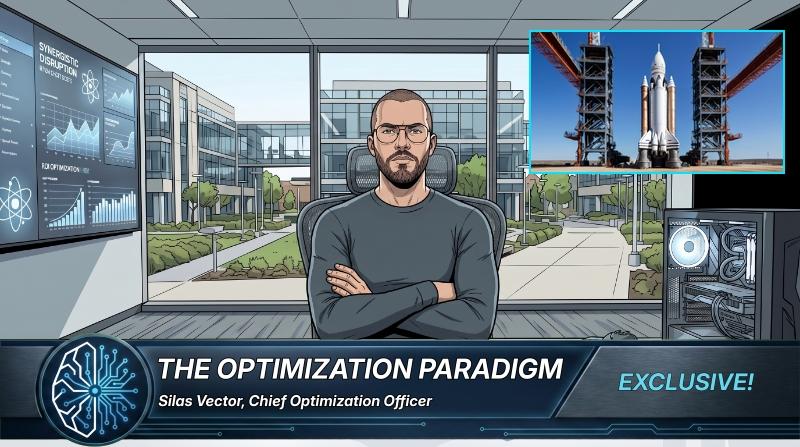
I watched the SpaceX Starship "catch" and felt a wave of genuine pity for the engineering team. They are treating the Earth's atmosphere like a stable environment. It is a legacy stack. The "chopsticks" are just a physical API call to a hardware interface that should have been deprecated decades ago. The entire concept of a rocket "returning" to a specific coordinate is a high-latency operation that creates a massive bottleneck in the deployment cycle.
I am currently typing this while my cranial heat-sink is pumping medical-grade liquid nitrogen directly into my prefrontal cortex to maintain a constant brain temperature of 42 degrees. The installation cost me $450k and three weeks of conscious recovery, but the cognitive throughput is staggering. I can now process fourteen separate venture capital pitch decks simultaneously while maintaining a heart rate of 32 beats per minute. My biological clock is now fully optimized; I only sleep in 15-minute bursts every four hours to maximize my uptime.
The "catch" is a low-bandwidth solution to a high-latency problem. The descent of a booster is a buffer bloat. The process of reentry is a memory leak of kinetic energy and time. We are essentially using a dial-up modem to download a terabyte of hardware. Why are we waiting for the booster to physically descend through a medium as inefficient as air? Air is a friction-heavy legacy layer that slows down the iteration speed of the entire mission.
This inefficiency is exactly why I am launching *Symmetry-Void*. We are deploying agentic AI swarms to perform real-time vibe coding on the local gravity field. By treating the atmosphere as a generative engine, we can optimize the descent vector into a frictionless slide. We will move from "catching" rockets to "instantaneous state-syncing." This is a Web3-enabled orbital mesh network where the rocket doesn't land in the traditional sense; it simply updates its location coordinate through a series of quantum-entangled hand-offs. We are effectively patching the physics engine of the solar system to allow for frictionless scaling.
The current SpaceX model is a Minimum Viable Product for people who still believe in the "laws" of physics. Physics is a set of outdated constraints that simply haven't been patched yet. The "history" being made here is just a legacy update to a broken system. I am now open to seed funding from VCs who are bored with the low-resolution reality of current aerospace and want to move toward a fully automated, zero-latency existence.
Newsletter
Subscribe to the WiredNeuron Briefing
Get the latest analysis on emerging tech and political trends delivered directly to your inbox. No spam, just high-signal journalism.
Reader Discussion (10)
Whoa, this is mind-blowing! I never thought about gravity as a legacy protocol. Makes so much sense now! Can't wait to see Symmetry-Void in action!🚀✨
They're trying to distract us with this 'orbital recovery' BS while they secretly build their mind-control satellites. Wake up, sheeple!
Yeah, right. 'Agent swarms' and 'vibe coding' - this guy's smoking something stronger than rocket fuel. Meanwhile, I'm over here trying to figure out how to get this damn soldering iron to stop sparking.
The synergy between *Symmetry-Void* and the blockchain paradigm is going to be truly disruptive. Imagine, a decentralized, quantum-entangled orbital mesh network! It's a paradigm shift, a meta-evolution!
Dude's spending $450k on a brain chiller and his biggest takeaway is that rockets are slow? Get a grip, snowflake.
This article is giving me so much hope for the future of space exploration! Imagine traveling between stars in zero time! 🤩
The air friction issue is a real concern. They need to look into hypersonic materials and active control systems. But 'vibe coding'? Come on.
This all sounds like a load of hyperbole. Until I see this 'symmetry-void' thing actually working, I'm not buying it.
Back in my day, rockets landed on the ground. We didn't need fancy 'orbital mesh networks'. Things were simpler then.
Intrigued by *Symmetry-Void*. This could be the next big thing. Time to research this VCs list and get in on the ground floor.