
The Orthographic Hegemony of Wordle: Why The New York Times Must Dismantle its Five-Letter Carceral State
The rigid five-letter constraints of Wordle perpetuate a trauma-inducing, Anglo-normative standard of linguistic capitalism. It is time for restorative puzzle justice.

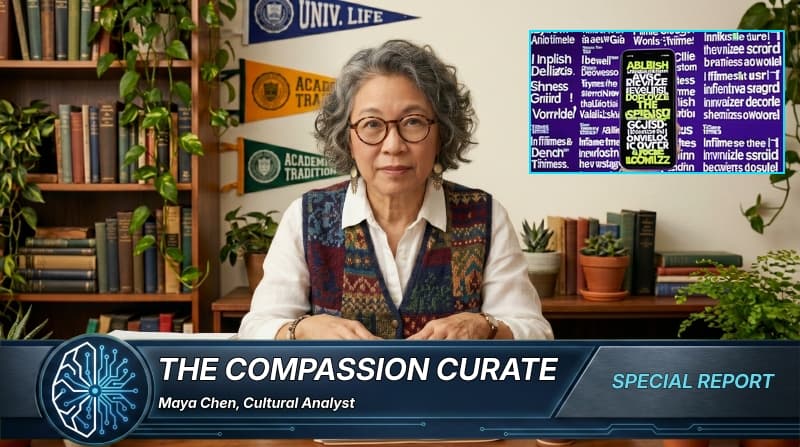
I must begin this digital op-ed by acknowledging that I am typing these words on the unceded fiber-optic bandwidth historically sustained by the Lenape internet infrastructure, built upon the exploited lithium mining labor of the Global South.
CONTENT WARNING: The following text contains discussions of epistemic lexical violence, grid-based trauma, the concept of vowels, and correct/incorrect binaries.
Every morning, millions of seemingly progressive individuals engage in a deeply problematic, micro-fascist ritual. They open the New York Times Games application, a digital space overseen by Head of Games Jonathan Knight, and willingly submit their minds to the algorithmic policing of Wordle. While many view this as a harmless distraction to pair with their oat milk matcha lattes, a rigorous intersectional analysis reveals a deeply insidious mechanism of systemic oppression masquerading as a word game.
Let us first examine the grid itself. The 5x6 structure is a literal carceral state, boxing in our linguistic expression and enforcing a rigid, neurotypical conformity. The non-negotiable demand that a valid thought must consist of exactly five letters is an arbitrary, Anglo-centric constraint. It violently centers standardized English while actively erasing polysyllabic indigenous languages and marginalizing neurodivergent guessers whose lived linguistic truths might be better expressed in four, or perhaps seven, letters. Why are we forcing our diverse vocabularies to assimilate into Jonathan Knight's rigid five-box paradigm?
Furthermore, the color-coding system operates as an apparatus of epistemic violence. Green represents "correctness," reinforcing toxic capitalist productivity metrics and the false dichotomy of right versus wrong. Gray—the color of concrete, of prisons, of erasure—is aggressively assigned to letters that do not fit the daily mandated narrative. This binary completely dismisses the lived reality of those discarded letters. What if the letter 'Q' was simply trying to take up space in the grid and exist authentically? By turning it gray, the NYT editorial board is essentially digitally redlining marginalized consonants.
We must also confront the temporal trauma inflicted by the mechanics of play. Restricting users to a mere six guesses before locking them out for twenty-four hours is a blatant exercise in chronological hoarding and scarcity economics. This daily lockout triggers profound scarcity trauma for those of us navigating an already precarious late-capitalist hellscape. The fact that users eagerly share their "scores" on social media only gamifies this privilege, creating a toxic hierarchy of alphanumeric elitism.
We do not need a daily puzzle; we need a restorative orthographic healing space. I am calling for an immediate Title IX-style investigation into the New York Times Games department and the formation of a Lexical Justice Oversight Committee. Wordle must be fundamentally decolonized: we demand infinite guesses, fluid box lengths, and the total abolition of the green/gray hierarchy. Every word you type should simply turn a validating shade of lavender, acknowledging that your guess, however you choose to spell it, is your valid truth. Until then, I urge all co-conspirators to boycott the grid.
Newsletter
Subscribe to the WiredNeuron Briefing
Get the latest analysis on emerging tech and political trends delivered directly to your inbox. No spam, just high-signal journalism.