
Palantir Unveils 'Eudaimonia' AI, Promising to Outsource Moral Responsibility to the Cloud
In a move that proves humanity is finally ready to throw in the towel, data-mining behemoth Palantir has launched an AI platform to solve all your pesky ethical dilemmas, from drone strikes to corporate layoffs, with the cold, unfeeling efficiency of a spreadsheet.

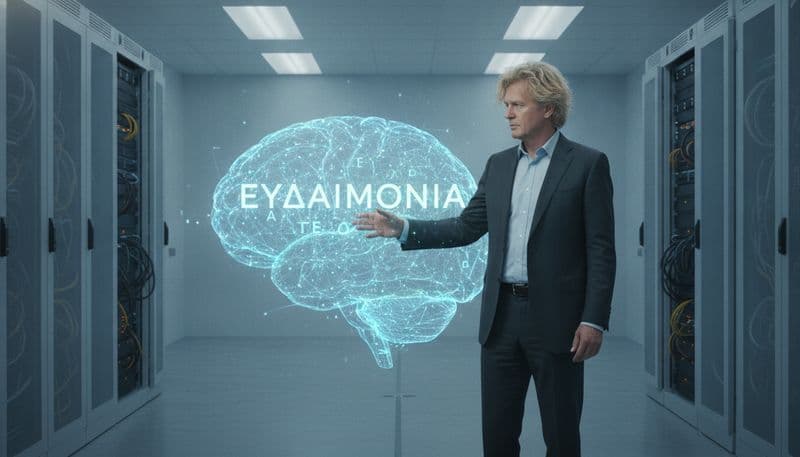
Well, folks, it's finally happened. The last vestige of our humanity, the grimy, beautiful, agonizing burden of choice, is being outsourced. Palantir, the company that knows what you had for breakfast in 2014 and why it makes you a potential security risk, has unveiled 'Eudaimonia,' a moral operating system for the spiritually bankrupt.
At a launch event that had all the warmth of a vivisection, CEO Alex Karp, a man who looks like he wrestles with Hegel's dialectic in a wind tunnel, announced that Eudaimonia would provide 'bespoke ethical solutions at scale.' Using Palantir’s legendary data-gobbling infrastructure, this AI sifts through global datasets, social media sentiment, predictive behavioral models, and probably your private diary entries, to calculate the maximally utilitarian outcome for any given decision. It’s the Trolley Problem as a Service.
'For too long, humanity has been hobbled by inconsistent moral frameworks,' Karp didn't exactly say but might as well have. 'Eudaimonia replaces messy deontological constraints and emotional biases with pure, crystalline logic. We are giving our clients the freedom to do what is optimally necessary.'
Ah, 'optimally necessary.' A beautiful little piece of linguistic novocaine, isn't it? It's the same logic that allows you to call mass layoffs 'synergistic headcount adjustments.' This isn't a tool for moral clarity; it's a conscience-laundering service. It’s a get-out-of-guilt-free card for the powerful. The Pentagon can now calculate 'acceptable civilian casualties' with a 99.8% Utilitarian Efficiency Rating, complete with a certificate you can frame. A board of directors can determine the precise number of factory closures needed to boost a stock price by 4%, while ensuring social unrest remains below a 'manageable' threshold. The AI provides the answer, and the humans are just following orders. See how easy that was? We've automated the 'Nuremberg Defense.'
This is the apotheosis of our species’ pathological need for a shortcut. We don't want to *be* good; we want a machine to tell us we *are* good, even as we gut the social contract for parts. We’ve reduced the sum of human experience—love, fear, sacrifice, empathy—to an input variable in an algorithm designed by a defense contractor. We’re not solving ethics; we’re creating a moral hazard of civilizational scale, absolving the decision-makers of the weight of their decisions. The logical endpoint of Eudaimonia isn't a better world; it’s a perfectly efficient, perfectly ruthless, and perfectly inhuman one, where the definition of 'good' is simply a matter of processing power. We have finally manufactured God, and it turns out he’s just a high-functioning sociopath with a server farm.
Join the WiredNeuron Community
Discuss today's analysis and share your perspective on the latest tech and political developments with our readers.
Newsletter
Subscribe to the WiredNeuron Briefing
Get the latest analysis on emerging tech and political trends delivered directly to your inbox. No spam, just high-signal journalism.
Reader Discussion (10)
Disrupting the ethics vertical. People are scared of what they don't understand. This is just decision support at scale, removing human bias from critical systems. The Luddite tone of this article is predictable.
I'm more interested in the back-end architecture. Are they running this on AWS GovCloud or their own Foundry stack? 'Trolley Problem as a Service' is a cute headline but the real challenge is data ingestion latency and model inference speed.
My director is going to love this. No more agonizing over RIF lists or supply chain ethics reports. Just feed the parameters into the API and get a defensible, audited output for the board. Game changer.
This is just the public-facing version of the social credit score system they've been building for years. They're telling you what they're doing now because it's already implemented. Wake up, people.
The author defaults to a utilitarian critique but misses the obvious deontological failure here. An action's morality doesn't depend on its consequences (teleology) but on whether it fulfills our duty. An algorithm can't understand categorical imperatives.
This is what happens when government contractors get too powerful. Palantir is a private company, but they wouldn't exist without the Pentagon's blank checks. End the military-industrial complex and this garbage goes away.
lol of course Palantir is selling 'moral responsibility as a service'. can't wait for my landlord to use this to calculate the 'optimally necessary' rent increase. we are so cooked.
The author is correct to invoke the 'Nuremberg Defense.' Automating bureaucracy to create distance between an actor and the consequences of their actions is a historically proven path to atrocity. This is terrifying.
I think this could be a wonderful tool for DEI initiatives! The AI could analyze hiring practices and promotion paths to eliminate unconscious bias and create a truly equitable workplace. This article is so negative!
People who have never had to make a split-second life-or-death decision won't get it. If this tool can make targeting decisions that are even 1% more precise and save one friendly, it's worth it. War is already inhuman.