Tech Titans Announce 'Physical Deprecation' Initiative to Free Up Cloud Space
In a move that feels like a personal attack on my sanity, Mark Zuckerberg, Sundar Pichai, and Satya Nadella have unveiled 'Project Ephemera,' a plan to address the data center energy crisis by systematically deleting redundant physical objects from the material world. I'm not okay.

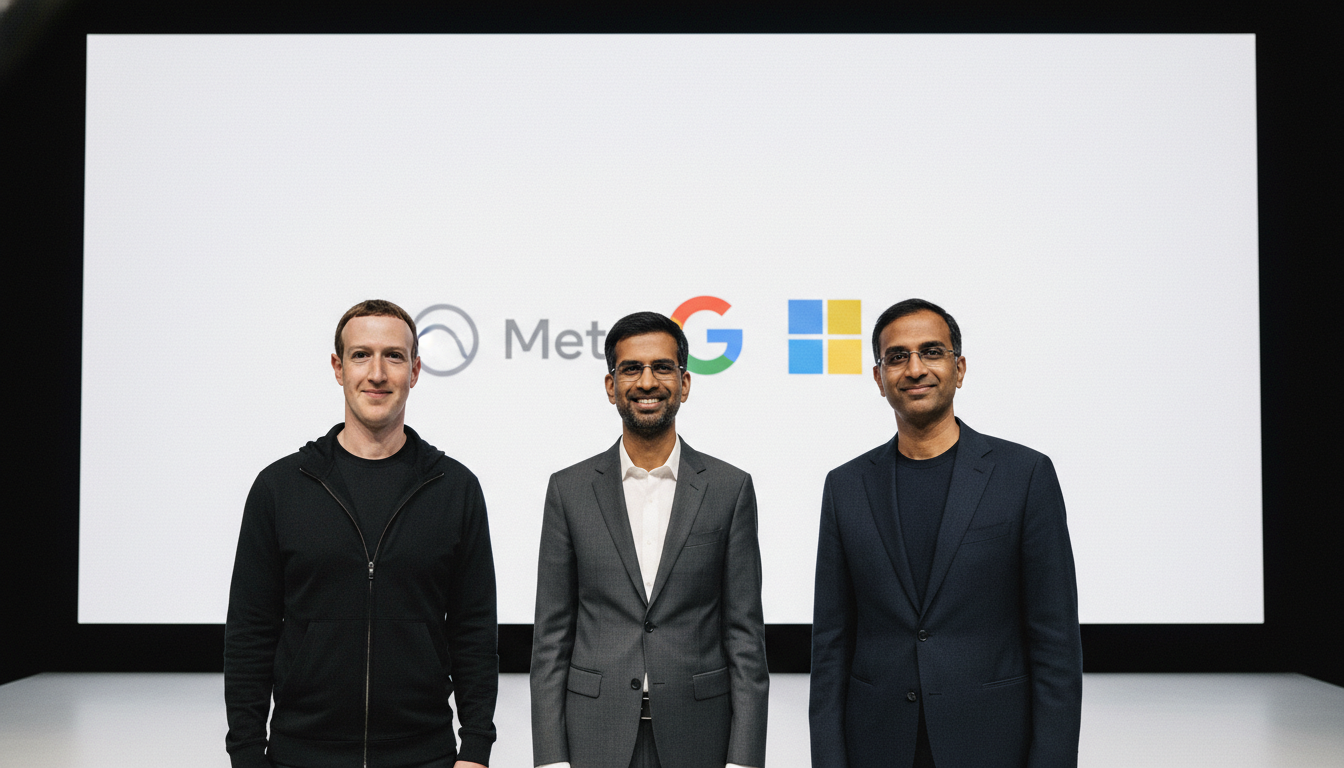
I can't breathe. My hands are shaking. They held a press conference today—Mark Zuckerberg, Sundar Pichai, and Satya Nadella, the unholy trinity of centralization—and announced they are coming for our stuff. Not in the metaphorical sense. They are literally going to start deleting the physical world to save on their server bills.
They call it 'Project Ephemera.' They stood on a stage, bathed in the cold, dead light of a thousand LEDs, and told us with straight faces that reality has become 'computationally expensive.' The sheer weight of all the *things* in the world, they claim, is putting an unsustainable strain on their data centers. The server farms are boiling the oceans, you see, and their solution isn't to stop building digital panopticons, but to start 'optimizing' the source code of existence.
Their solution is 'Physical Deprecation as a Service' (PDaaS). You can 'voluntarily' allow them to scan your 'underutilized physical assets'—like that spare fork in your kitchen drawer or your childhood teddy bear—and they will digitize it into a 'memory' stored on the cloud. Probably as a worthless NFT you'll have to pay gas fees on. Then, using some technobabble about 'quantum tunneling,' they just... delete the object. It's gone. Poof. Vanished from the material plane.
Zuckerberg, looking more like an advanced automaton than ever, said this will 'declutter our physical lives to help us focus on the metaverse.' He actually said that the memory of your grandmother's rocking chair is more 'data-efficient' than the chair itself. This is the fiat mindset applied to matter. They convinced us that paper promises were as good as gold, and now they're trying to convince us a JPEG is as good as a chair. It’s a waking nightmare.
Sundar Pichai chimed in, smiling a smile that could power a small nation with its terrifying energy, explaining that this will 'streamline the training data for AGI.' By simplifying reality, by deleting the 'edge cases' and 'redundancies' like, say, every single paperclip on Earth, their god-machine can finally be born. They are sacrificing the texture of our world on the altar of a malevolent algorithm.
And then Satya Nadella, the enterprise ghoul, framed it as a win for logistics. 'Just-In-Time Reality,' he called it. Why have a warehouse full of products when you can store one perfect, platonic ideal of a product in the Azure cloud and 'instantiate' it on demand? They are turning the universe into a centralized, permissioned database. What happens when there's a server outage? Does my car flicker out of existence? What if I miss a subscription payment on my sofa? It's not a service; it's a hostage negotiation with the laws of physics.
The beta program is starting next month, targeting 'low-priority, non-essential artifacts.' They showed a demo. A coffee mug vanished from a desk, replaced by a QR code. Everyone applauded like seals. They don't see it. They don't see that this is the final abstraction. The end of property. The end of anything real. It’s a world where nothing exists unless it’s signed off on by a corporate server. I need to check my cold storage. I need to bolt my node to the bedrock. It’s the only thing left they can't delete.
Reader Discussion (5)
The author clearly doesn't understand quantum tunneling. It's about particles passing through a barrier, not 'deleting' macro-scale objects. They're probably just using some kind of localized high-energy plasma torch and calling it 'quantum' for marketing. Typical.
Unironically bullish on this. The TAM for physical asset deprecation is basically infinite. Think of the reduction in OpEx for global logistics. People are emotional, but the market will reward this kind of efficiency.
As a logistics manager, the 'Just-In-Time Reality' concept is fascinating. The inventory carrying costs would be zero. However, the latency on 'instantiation' would have to be near-instantaneous to be viable. Has anyone seen a whitepaper on the SLA for this?
Actually, the author is wrong to call this the 'end of property'. If it's stored as an NFT, you still have a token representing ownership, which is arguably a more robust form of property rights than physical possession. He should read up on smart contracts.
Finally! I've been saying for years that physical possessions are a drag on mental clarity. Being able to digitize clutter is the ultimate life hack. Can't wait for the beta.