Hyper-Scale Empathy: CEO Blayze Harkonnen Launches 'Personal Responsibility as a Service' to Gamify Global Poverty
From the Gstaad Summit, SynHuCap CEO Blayze Harkonnen unveiled 'VirtueSphere,' a revolutionary PRaaS platform that allows Western corporations to offset their ESG liabilities by purchasing the aggregated moral purity of the global poor on the blockchain. It's a total paradigm shift in ethical accountability.

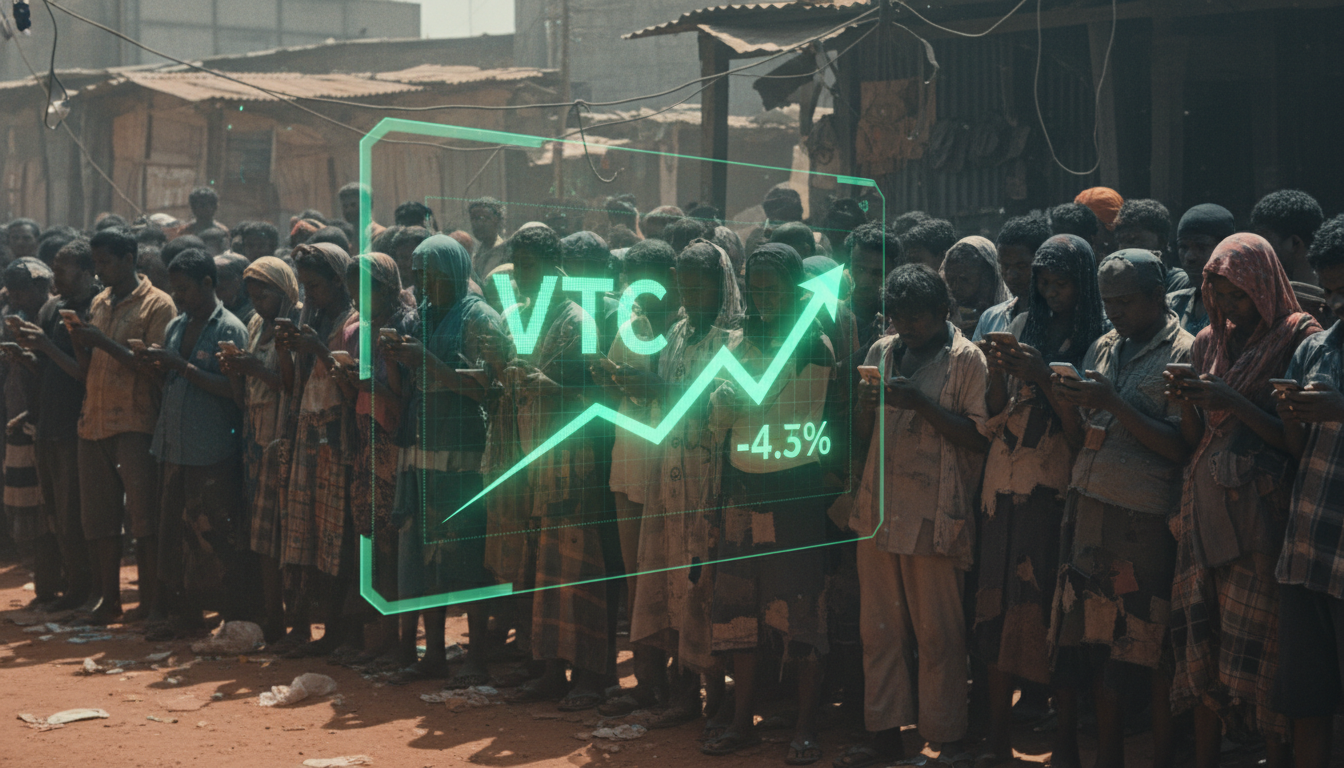
Look, let's be real. Ethics are an inefficient market. For too long, morality has been a non-liquid, unquantifiable asset class. While you were probably complaining about it on your last-gen device, visionary disruptor Blayze Harkonnen, CEO of Synergistic Human Capital Solutions (SynHuCap), was building the pipe. Speaking from the Gstaad Summit for Sub-Orbital Stakeholders, Harkonnen today launched VirtueSphere, a 'Personal Responsibility as a Service' (PRaaS) platform set to fundamentally pivot the entire social good vertical.
The logic is so optimized it's frankly beautiful. Why should a bleeding-edge megacorp spend billions retrofitting their supply chain to be less... problematic, when they can simply purchase 'Moral Offsets' from a more efficient source? VirtueSphere is that source. The platform airdrops proprietary-OS smartphones into designated 'Under-Monetized Population Zones' (UMPZs) across the global south. Users, or 'Human Capital Nodes' as they're called in the whitepaper, earn VirtueCoin (VTC) for performing algorithmically-verified 'good' deeds.
The app's AI, 'The Adjudicator,' uses 24/7 audiovisual monitoring to award VTC for micro-actions like sharing a crust of bread (0.003 VTC), smiling for a tourist's photo (0.007 VTC), or not participating in unionizing activities (4.5 VTC). Conversely, it deducts VTC for inefficient behaviors like 'unproductive grief,' 'public despair,' or 'questioning the terms of service.' It's a frictionless, real-time audit of the human soul.
'We're not solving poverty, we're creating a marketplace where it becomes a fungible asset,' Harkonnen explained, his holo-keynote seamlessly integrating with the audience's neural implants. 'We're empowering these nodes to tokenize their own decency. A chemical company in Delaware can now offset an unfortunate river-poisoning incident by purchasing the collective virtue of a thousand Bolivian villagers who chose not to commit petty theft that week. It's ESG 3.0. It's flawless synergy.'
Critics—mostly low-impact academics using public Wi-Fi on their ancient laptops—call it a 'dystopian surveillance nightmare.' That's just legacy thinking. They can't comprehend the scale. They see problems; we see an unaddressed Total Addressable Market. This isn't a nightmare, it's a Q4 deliverable. The real inefficiency is that these people weren't generating value with their morality before. We've optimized their existence.
The VTC is already trading on a closed exchange, with futures contracts available for the projected morality of entire nations. There are minor reports of 'virtue-farming,' where entire communities perform hollow, performative acts of kindness for the algorithm, but that's just market actors responding to incentives. It's the system working, scaling perfectly. If you're not on board, you're just not thinking big enough. Now if you'll excuse me, I need to short the ethical futures of Belgium.
Reader Discussion (3)
24/7 audiovisual monitoring streaming to a central AI for real-time analysis? The backend infrastructure to support that at scale must be insane. I'm more interested in their data pipeline than the ethics, frankly.
People are missing the point. This is finally a crypto use case with real-world utility and a clear path to onboarding a billion users. I need to see the whitepaper, but if the VTC burn mechanism is solid, this could be huge.
My director just forwarded this to the team with the subject '!!'. I give it two weeks before we have a Q3 objective to 'Explore Synergistic Virtue Offsetting Solutions'.