
The Professional Purgatory: Why LinkedIn’s ‘Truth-Verify’ is the Final Liquidation of the Ontological Self
By attempting to purge the "fake" from the professional sphere, LinkedIn has inadvertently created a digital guillotine where a payroll API glitch can effectively erase a human being from existence.

I have spent the better part of two decades studying the teleology of failure, and I must say, the sheer, unadulterated hubris required to "clean up" a professional networking site is a masterpiece of systemic blindness. LinkedIn’s recent pivot toward aggressive "Truth-Verify" tools—designed to excise the phantom consultants and the imaginative resume-padders—is not a victory for authenticity. It is the final, desperate attempt to collapse the distance between a human being and their utility-value to the state and the corporation.
We are witnessing the transition from a semiotic representation of a career to a hard-coded, biometric ledger of obedience. By integrating real-time payroll APIs, tax record synchronization, and biometric timestamping to "prove" work history, LinkedIn is no longer a social network; it is a centralized registry of ontological validity. They are not fighting "fake profiles"; they are establishing a regime of epistemic closure where your existence is contingent upon a third-party server’s willingness to acknowledge your employment.
Let us follow the logical trajectory to its inevitable, mundane conclusion. First, the "Verification Badge" becomes the prerequisite for any high-level employment. To lack the badge is to be a ghost, a professional pariah. Second, because the system relies on a fragile web of integrations with legacy payroll systems like ADP and Workday, any discrepancy—a clerical error in a mid-level HR office in Des Moines, a botched database migration, or a simple API timeout—results in an immediate "Verification Failure."
The escalation is not a sudden explosion, but a slow, bureaucratic strangulation. Once the "Truth-Verify" system is integrated into the broader corporate ecosystem, the "Verification Failure" triggers an automatic lockout. Because these systems are designed for "security" and "integrity," a failure to verify one's history is treated as a fraudulent intrusion.
The apocalypse arrives not with a bang, but with a 404 error. Imagine the scene: a critical mass of mid-to-upper management—the people who actually know where the digital keys are kept—suddenly find themselves flagged as "fictional" due to a synchronization lag during a routine software update. Within an hour, these individuals are locked out of their corporate emails, their building badges are deactivated, and their direct deposits are frozen by banks that now use LinkedIn’s verification as a proxy for KYC compliance.
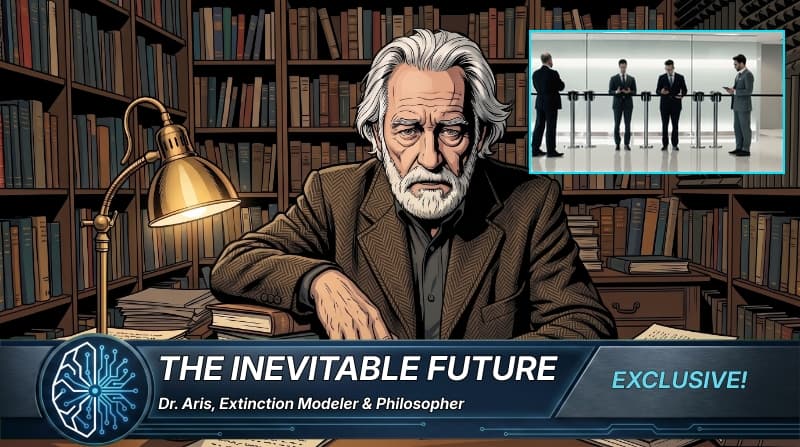
We will reach a state of total administrative paralysis. The people tasked with fixing the glitch are themselves flagged as fraudulent. The technicians cannot enter the server rooms because their identities have been liquidated by the very algorithm they are meant to maintain. We will be left with a global workforce of highly qualified ghosts, standing in sterile lobbies, unable to prove they exist because the ledger that defines "existence" has suffered a momentary lapse in connectivity. It is the ultimate irony: in the quest to eliminate the "fake," we have rendered the "real" entirely disposable.
Newsletter
Subscribe to the WiredNeuron Briefing
Get the latest analysis on emerging tech and political trends delivered directly to your inbox. No spam, just high-signal journalism.
Reader Discussion (2)
This is just fearmongering. I'm sure they've got robust fail-safes in place. Besides, if you're qualified, you have nothing to worry about. /s (but seriously, who hasn't had a weird payroll glitch?)
Been saying this for years. We're building tools to control, not connect. They'll use 'security' as an excuse for more surveillance. It's all about power, not authenticity. #TechOverlords