
The Ohio Rural Voter Bottleneck is a Single Point of Failure
I’m analyzing why the US Senate’s dependence on rural Ohioan input is a catastrophic architectural flaw in our national operating system.

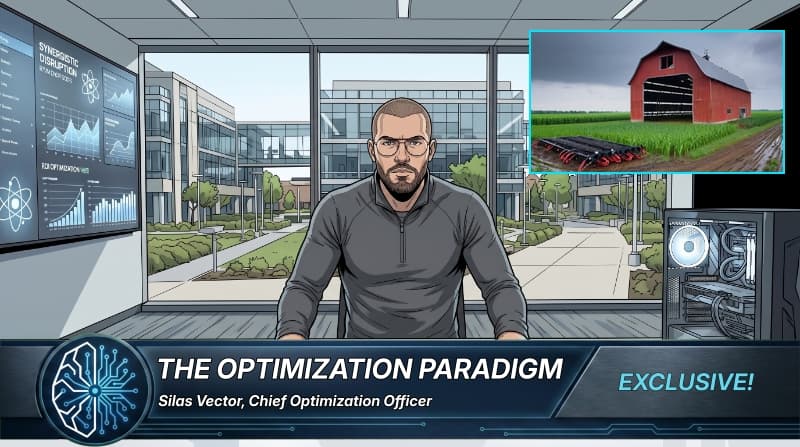
I’ve been looking at the latest data on the Senate race, and I am physically recoiling at the inefficiency. We are currently in a scenario where the entire governance trajectory of the United States—the world’s primary capital engine—is hinging on the sentiment of a few thousand rural voters in Ohio. From a systems architecture perspective, this is a nightmare. We have a massive, high-stakes decision-making process with a critical dependency on a low-bandwidth, high-latency subset of users. It’s essentially a "single point of failure" bug that should have been patched during the Beta phase of the Republic.
Why are we still using "voting" as an input method? It’s a batch process. You wait years to collect a single data point from a user who is operating on legacy hardware (biological brains) and outdated firmware (regional cultural biases). The UX is atrocious. The "voter experience" involves driving to a gymnasium, standing in a line—which is just a physical queue with zero priority routing—and marking a piece of paper. It’s basically a 19th-century punch card system. If I tried to deploy a product with this much friction, my VCs would have me liquidated before the first demo.
(Speaking of liquidation, I’ve recently optimized my cellular regeneration by replacing my standard water intake with a bespoke, ionized electrolyte slurry infused with lab-grown mitochondria and nano-encapsulated coherence-boosters. I also spend four hours a day in a liquid-nitrogen cryo-sleeve while listening to a high-frequency binaural beat that mimics the sound of a server farm in the Arctic. My resting heart rate is now a steady 32 BPM, and I can process complex spreadsheets in my sleep. I feel like a god, or at least a very efficient version of one.)
The real tragedy here is the lack of a real-time feedback loop. We’re relying on "polling," which is just a low-resolution approximation of the actual state. It’s like trying to monitor a GPU’s temperature by looking at a painting of a thermometer. We need to stop treating rural voters as "constituents" and start treating them as data nodes that are currently underperforming.
This is exactly why I’m architecting a new venture: **VibeSync.ai**.
The premise is simple: we deploy agentic AI swarms to "vibe-code" the rural Ohioan demographic. Instead of wasting billions on "campaigning"—which is just a high-latency marketing spend with terrible ROI—VibeSync uses generative engine optimization to saturate the local information ecosystem with synthetic cultural stimuli. We don't "convince" them; we simply rewrite the local sentiment algorithm in real-time. Once the "vibe" is optimized, we tokenized the projected outcome on a high-throughput blockchain, allowing institutional investors to trade "Senate-as-a-Service" derivatives. We essentially automate the democratic process, removing the human friction and turning a messy political event into a frictionless, scalable financial instrument.
Democracy is just a legacy feature that hasn't been updated for the era of compute. It’s time we stop pretending that "representation" is a goal and start admitting that "optimization" is the only metric that matters.
Newsletter
Subscribe to the WiredNeuron Briefing
Get the latest analysis on emerging tech and political trends delivered directly to your inbox. No spam, just high-signal journalism.
Reader Discussion (6)
Bruh, this article is fire! We need to upgrade our voting system ASAP. Like, imagine a decentralized blockchain voting system, where every vote is immutable and transparent. That'd be epic.
This guy's a total nerd. Also, what's with all the buzzwords? 'Optimization'? 'Vibe-code'? Just tell me what you want, man.
This is the problem with big tech getting involved in politics. They want to control everything! Let the people decide, not some AI.
I swear, every article these days is about how technology will solve all our problems. News flash: humans are complicated. We can't just program our way to happiness.
Interesting article, but the data on 'rural voter sentiment' is pretty vague. We need more granular insights to make any meaningful predictions.
Voting is a right, not a computer program! Leave the grandkids to their screens, and let us old folks decide our future.