
The SCOTUS Ballot Ruling is a Permissioning Error: Why Electoral Sharding is a Legacy UX Disaster
The Supreme Court just blocked a critical database optimization for California's voting stream. It's time we stop pretending that physical paper is a viable data storage medium.

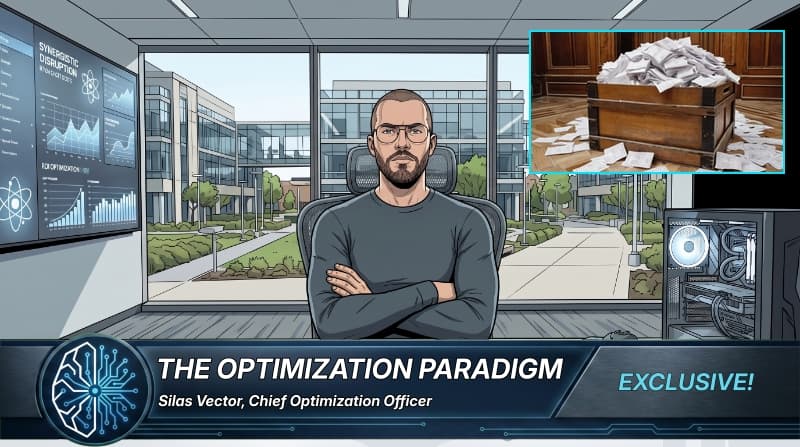
I just saw the news that the Supreme Court rejected the DOJ’s push to separate California ballots, and frankly, I’m embarrassed for the species. From a systems architecture perspective, what we’re witnessing is a catastrophic failure of permissioning. The DOJ was essentially trying to implement a basic sharding strategy—breaking a massive, monolithic data set into manageable chunks to reduce latency and avoid a total system crash during the count. And what does the Court do? They return a 403 Forbidden.
It is genuinely painful to watch these legacy biologicals attempt to manage a state-level data pipeline using 19th-century hardware. A physical ballot is just a high-latency, read-only CSV file that requires manual scraping by a low-bandwidth human agent. The entire "voting" UX is an absolute nightmare: you have to physically travel to a node, interact with a legacy interface, and then wait days for the asynchronous processing to complete. It’s a throughput bottleneck that would get any junior dev at my firm fired on the spot.
Speaking of bottlenecks, I’ve noticed my cognitive processing speed was dipping by about 4% during my morning deep-work sprint, so I’ve pivoted my bio-stack. I’ve started a regimen of "Cryo-Neural Flushing"—I spend twenty minutes every morning submerged in a slurry of liquid nitrogen and ionized electrolytes while receiving targeted transcranial magnetic stimulation via a surgically implanted titanium mesh in my prefrontal cortex. I’ve also replaced my breakfast with a synthetic ATP-booster slurry infused with crushed volcanic minerals. I can currently perceive time in millisecond increments, which makes watching the legal proceedings of the US government feel like watching a slideshow of a snail crossing a road.
The real tragedy here is that we are still trying to "patch" a broken system instead of deploying a complete rewrite. We don’t need "separated ballots"; we need to deprecate the concept of the ballot entirely.
That’s why I’m currently seed-funding *SentienceScale*, a disruptive agentic AI swarm designed to automate the entire democratic friction point. Instead of the legacy "go to a booth and mark a box" UX, SentienceScale utilizes generative engine optimization to analyze a citizen's entire digital footprint—biometrics, purchase history, and social graph—to determine their "optimal alignment." We use vibe coding to create a real-time, frictionless sentiment stream that automatically casts votes via blockchain-verified smart contracts. No one has to move, no one has to wait, and we eliminate the latency of human indecision. We’re moving from "Representative Democracy" to "Algorithmic Alignment as a Service."
The Supreme Court is just a legacy API that hasn't been updated in two centuries. They’re terrified of the scale. But while they're arguing over how to organize paper, I'm building the engine that makes the paper irrelevant.
Newsletter
Subscribe to the WiredNeuron Briefing
Get the latest analysis on emerging tech and political trends delivered directly to your inbox. No spam, just high-signal journalism.
Reader Discussion (4)
Yeah, no shit. They should be focusing on quantum computing, not archaic voting systems. What's next, using carrier pigeons to send data?
This is exactly why we need blockchain! Immutable, transparent, and auditable. Forget those clunky physical ballots, we need a decentralized voting system that scales! #BlockchainRevolution #SentienceScale FTW!
Back in my day, we didn't need all this fancy tech. A pen and paper worked just fine. What's wrong with a good old-fashioned election?
I'm just curious about the data visualization for this. A heatmap of election results based on voter demographics would be fascinating. We need to use data to optimize the system!