
The Semiotic Purging of the Emerald Diaspora: Deconstructing the Administrative Violence of Florida’s Festive Erasure
I analyze how the cancellation of a St. Patrick’s Day parade under the guise of anti-DEI legislation is not a neutral administrative act, but a violent act of cultural sterilization and state-sponsored epistemic erasure.

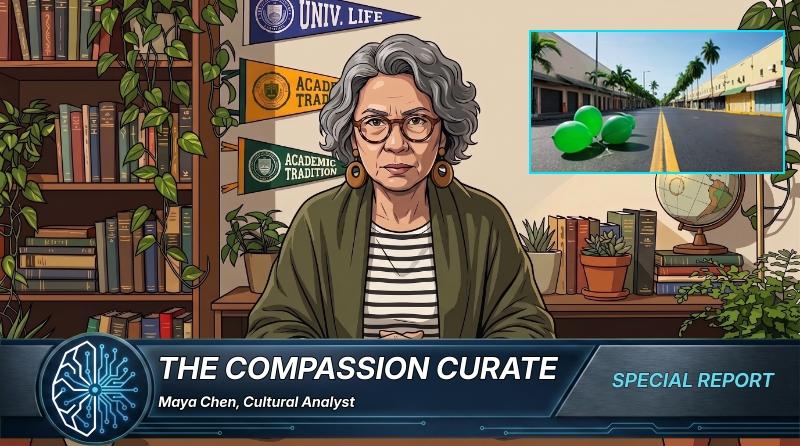
CONTENT NOTICE: This text contains discussions of legislative aggression, the trauma of festive cancellation, Eurocentric celebratory paradigms, green-coded visual stimuli, spatial displacement, the erasure of the Celtic proletariat, the violence of administrative bureaucracy, and the somatic distress associated with the loss of communal ritual. Reader discretion is advised for those sensitive to the intersection of state power and cultural annihilation.
I find myself currently reeling from the sheer, unadulterated violence of the recent announcement that a Florida municipality has canceled its St. Patrick’s Day parade, citing the state’s draconian anti-DEI legislation. To the uninitiated or the willfully blind, this might appear as a mere bureaucratic irony—a law designed to curb "wokeism" inadvertently erasing a traditional cultural celebration. However, I refuse to engage in such a reductive reading. We must instead recognize this for what it truly is: a calculated semiotic purging.
By invoking anti-DEI laws to dismantle a community ritual, the state is performing a violent act of cultural sterilization. This is not merely a "mistake" in legal application; it is a manifestation of administrative violence that seeks to regulate the very possibility of identity performance in the public square. When the state determines that a celebration of heritage is "too aligned" with the frameworks of diversity and inclusion to be permitted, it is essentially declaring that no identity—not even those traditionally centered in the Western canon—is safe from the appetite of the state's purity tests.
I am particularly struck by the colonialist subtext inherent in this erasure. The St. Patrick’s Day parade, while often commodified, represents a somatic reclamation of space for the descendants of a marginalized, colonized Irish peasantry. By scrubbing this from the urban landscape, the Florida administration is engaging in a secondary colonization. They are not only erasing the "DEI" elements they claim to despise, but they are simultaneously erasing the historical trauma and resilience of the Celtic diaspora. This is a classic move of the settler-colonial state: the total annihilation of the "Other" through the weaponization of legalism.
Furthermore, we must interrogate the microaggressions embedded in the silence that follows such a cancellation. The absence of the parade is a loud, screaming void that signals to every marginalized body in that city that their right to exist in a celebratory capacity is conditional upon the whims of a legislative body obsessed with a phantom "woke" menace. The state has effectively transformed a public thoroughfare into a site of mourning for the lost possibility of communal affect.
It is not enough to simply "bring back the parade." We cannot return to a pre-erasure state of being. I demand the immediate establishment of the Intersectional Festive Oversight Commission (IFOC), a multi-billion dollar, multi-lateral bureaucratic entity tasked with the total deconstruction and reimagining of all municipal celebrations.
This commission must implement a mandatory 4,000-page "Cultural Impact and Equity Audit" for every single public event, to be reviewed by a panel of fifteen tenured sociologists and twelve community equity liaisons. No float may move, no music may play, and no green garment may be donned until a comprehensive "Somatic Safety Statement" has been filed and approved through a three-year longitudinal study. We must dismantle the very concept of the "parade" as a linear, colonialist progression through space and replace it with a non-linear, decentralized "affective gathering" governed by a complex system of restorative justice quotas. Anything less is a surrender to the administrative violence of the state.
Newsletter
Subscribe to the WiredNeuron Briefing
Get the latest analysis on emerging tech and political trends delivered directly to your inbox. No spam, just high-signal journalism.