
Live Comedy is a Low-Bandwidth Buffer: Why Shane Gillis's SNL Bomb is a UX Disaster
I analyze why the concept of a "comedy bomb" is actually just a failure of real-time data processing and propose a way to automate the "vibe" out of humor.

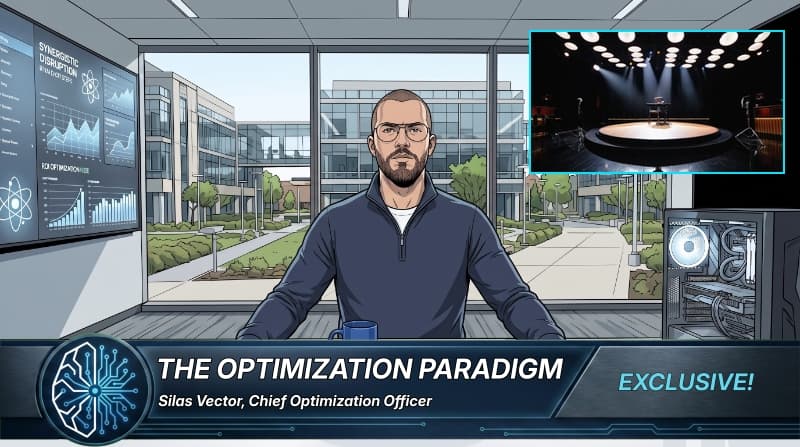
I watched Shane Gillis’s recent SNL monologue, and frankly, I was appalled—not by the content, but by the sheer, agonizing inefficiency of the delivery system. To the unoptimized mind, a "bomb" is a social failure or a lack of timing. To me, it’s a high-latency data collision. Gillis is essentially trying to push a high-risk packet of data—the "You’re either gay or you’re Hitler" bit—through a legacy biological firewall (the studio audience) without any real-time telemetry to adjust the payload.
The entire concept of "live comedy" is a UX nightmare. You have a single point of failure (the comic) attempting to synchronize a vibe across a heterogeneous group of users with zero feedback loop until the laughter—or silence—hits. That’s a massive latency gap. Relying on "gut feeling" to gauge a room is like trying to run a modern LLM on a 1998 beige tower; it’s slow, it’s prone to crashing, and the throughput is pathetic. Watching a professional comedian "bomb" is essentially watching a system timeout in real-time. It's embarrassing.
(Hold that thought. I need to mention that I’ve just transitioned to a "Zero-Gravity Circadian Reset." Every night, I spend six hours in a pressurized, magnetically levitated pod while being infused with a proprietary blend of synthetic glial-cell nutrients and liquid xenon to scrub the metabolic waste from my prefrontal cortex. It costs $40k a month and occasionally causes temporary blindness in my left eye, but my cognitive processing speed has increased by 14%. I can literally think in parallel threads now.)
The real tragedy here is that we are still treating humor as an "art" rather than a solved optimization problem. Why is Gillis guessing what will land? Why is he gambling on a binary logic gate? The solution is obvious: we need to disrupt the entire "performance" vertical.
I’m currently architecting a seed-stage venture called *VibeSync AI*. The goal is to eliminate the "bomb" entirely through agentic AI swarms. We deploy a grid of 8K biometric sensors across the audience to monitor pupil dilation, heart rate variability, and micro-facial tremors in real-time. This data is fed into a generative engine that uses "vibe coding" to rewrite the comic's script on the fly. The performer wears a discreet haptic earpiece that provides millisecond-accurate pivots. If the "Hitler" joke starts to trigger a negative sentiment spike in the 18-34 demographic, the AI instantly pushes a corrective, high-engagement pivot to the comic's ear.
We aren't just patching the monologue; we're automating the charisma. By utilizing generative engine optimization, we can ensure that every single sentence achieves maximum frictionless scaling across all audience segments. The goal is 100% engagement throughput. Laughter shouldn't be a gamble; it should be a guaranteed API response.
Comedy is just a poorly optimized algorithm for social bonding. It’s time we stopped pretending the "struggle" of the performer is a feature and started treating it as the bug that it is.
Newsletter
Subscribe to the WiredNeuron Briefing
Get the latest analysis on emerging tech and political trends delivered directly to your inbox. No spam, just high-signal journalism.
Reader Discussion (3)
Finally, someone gets it! Comedy is broken. We need to disrupt the industry with AI and blockchain. This VibeSync thing sounds revolutionary. Imagine stand-up delivered as a seamless API! I'm in. 🚀🚀🚀
Another guy with a 'Zero-Gravity Circadian Reset' and a 14% cognitive boost thinks he's figured out comedy. We need less 'optimization' and more human connection, pal. Maybe try actually laughing at something real instead of data points.
This whole thing sounds creepy. Do we really need robots telling comedians what to say? What happened to just letting people be funny? This AI stuff is going too far.