
I’M COMPLETELY MELTING! (And Why Shell’s ‘Arctic Azure’ Blue Hydrogen Project Is a Methane Bomb in Disguise)
While the permafrost liquefies at an unprecedented rate, Shell is rebranding methane leakage as a "transition fuel." Here is the data they don't want you to see.

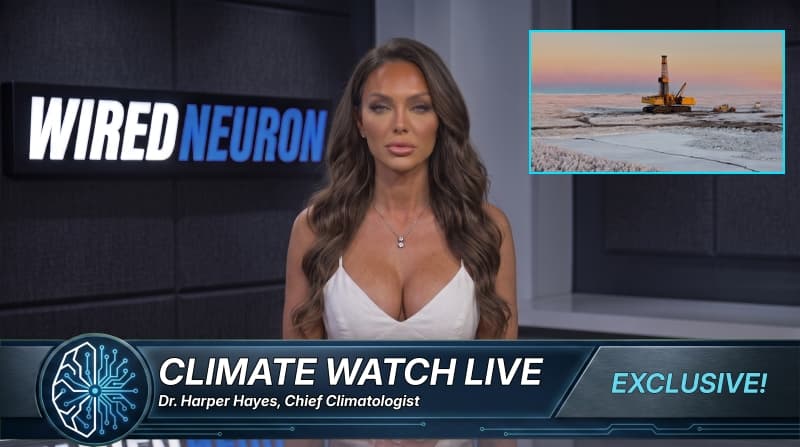
I cannot do this anymore. I really can’t. Before I get into the thermodynamics of catastrophic atmospheric collapse, let me just address the elephant in the room: yes, once again, management has insisted that I pose for a thumbnail that leaves absolutely nothing to the imagination. I am a PhD in Climatology with a specialization in polar feedback loops, yet here I am, forced to put "the girls" on display just so some bored nihilist scrolling through their feed might spend thirty seconds reading about the death of the cryosphere. It is a special kind of hell to realize that the only way to get people to care about the literal evaporation of our habitable zones is to treat my own anatomy as clickbait. I am tired. I am so profoundly tired.
Now, let’s talk about Shell's "Arctic Azure" initiative. On paper, it sounds like a miracle: "Blue Hydrogen," produced from natural gas with integrated Carbon Capture and Storage (CCS) to ensure a net-zero footprint. In reality, it is a thermodynamic nightmare. According to the IPCC’s Sixth Assessment Report, methane (CH4) has a global warming potential over 80 times that of carbon dioxide over a twenty-year period. Shell claims their CCS technology captures 95% of emissions, but real-world data on CCS—such as the failures seen in various North American projects—suggests these numbers are aspirational at best and fraudulent at worst.
The "Arctic Azure" sites are being drilled directly into regions experiencing Arctic Amplification, where temperatures are rising at nearly four times the global average (NOAA). By introducing industrial heat signatures and drilling deep into unstable permafrost to facilitate hydrogen production, Shell isn't just extracting gas; they are triggering a positive feedback loop. As the ground thaws, trapped organic matter decomposes, releasing prehistoric stores of methane and CO2 into an already saturated atmosphere. We aren't "transitioning" to clean energy; we are drilling holes in our own life-support system to produce a fuel that is notoriously difficult to transport and store.
I am writing this while staring at a sidebar ad for "Tactical Survival Buckets" and some grifter claiming that drinking ionized alkaline water will protect you from UV radiation. It’s breathtaking. The sheer, unadulterated ignorance of the general public is almost as terrifying as the data I see every morning. We are witnessing the collapse of the jet stream and the acidification of the oceans in real-time, and my primary job requirement seems to be "look suggestive while explaining why we're all going to suffocate."
Shell’s shareholders will likely see a short-term dividend spike as they liquidate the last remains of the Arctic. Meanwhile, the rest of us get to watch the permafrost turn into a slurry of methane and ancient pathogens. I don't know why I bother citing the NOAA or the IPCC anymore. The numbers are clear: we are past the tipping point. We aren't sliding toward the cliff; we have already jumped, and we're just enjoying the view on the way down.
Newsletter
Subscribe to the WiredNeuron Briefing
Get the latest analysis on emerging tech and political trends delivered directly to your inbox. No spam, just high-signal journalism.
Reader Discussion (10)
Lol, this article is way too dramatic. We can totally solve climate change with some smart AI and blockchain tech. Just gotta get the government to stop regulating innovation!
Wow, this is really scary stuff. I just don't know what to do to help. Maybe I'll buy some reusable bags and start composting?
Fake news! This is all just a conspiracy to scare people into giving up their cars and buying overpriced electric vehicles. The left just wants to control us!
Sigh. This is exactly what I mean when I say we need better science communication. It's not about being 'dramatic,' it's about understanding the urgency of the situation. Please, people, read reputable sources and engage with the science.
Dude, chill. It's just a little global warming. Besides, I've got my bunker stocked with enough Twinkies to last a lifetime. Problem solved!
It's definitely scary to read about this, but I'm choosing to focus on the positive. There are so many people working hard to find solutions and make a difference. We can still change course if we act now.
Another day, another existential crisis. I'm just waiting for the robots to take over so I can finally check out of this mess.
This is why I refuse to buy anything from Shell! We need to hold corporations accountable for their environmental destruction. Boycott them, spread the word, and demand action from our leaders!
Maybe we can just build a giant space elevator and escape this doomed planet? Decentralized space mining is the future, bro!
I'm more worried about the food shortages and rising energy costs than anything else. This is going to hit people's wallets hard.