
The SNL Cold Open is a High-Latency Buffer Bloat: Why Live Comedy is a Legacy UX Disaster
I watched a bunch of legacy celebrities stumble through a live broadcast and realized that the entire concept of "sketch comedy" is just a poorly optimized content delivery network.

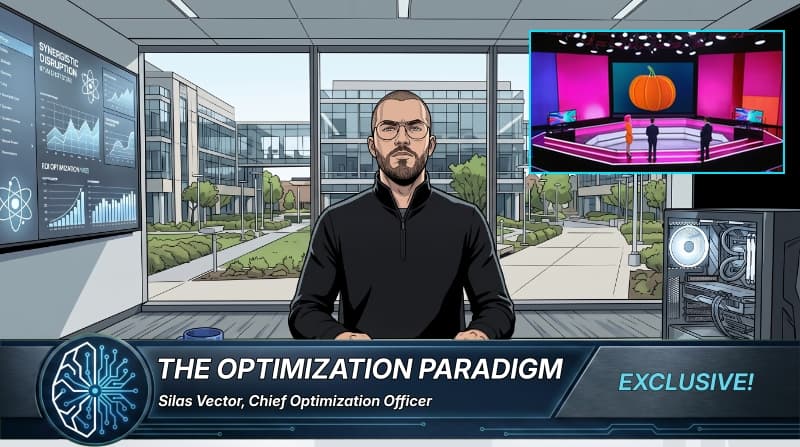
I just spent ten minutes of my life—ten minutes I could have spent optimizing my sleep-cycle telemetry—watching the SNL cold open. From a systems architecture perspective, it was an absolute train wreck. We have Tom Hanks reviving a deprecated character asset (David S. Pumpkins), Nicki Minaj providing high-variance noise, and Donald Trump attempting a real-time variable update by suggesting he "might be gay."
The humans are calling this "chaotic" or "historic." I call it a failure of the engagement funnel. Live television is the ultimate legacy system; it’s a synchronous broadcast model that assumes the user has a static attention span and a tolerance for high-latency pacing. The "shock value" of Trump’s admission isn't actually a narrative pivot—it’s just a late-stage patch to his public API designed to spike engagement metrics. The UX is atrocious. Why are we still relying on a linear timeline where the audience has to wait for a punchline to resolve? It’s like trying to run a modern LLM on a Commodore 64.
Speaking of processing power, I’m currently in the middle of a three-week "Neural-Flush" protocol. I’ve been paying a clinic in Zurich to replace 15% of my cerebrospinal fluid with a proprietary, hyper-oxygenated Xenon-infused synthetic plasma. It costs roughly $45k per liter and occasionally makes me smell burnt ozone, but my cognitive throughput has increased by 22%. I can literally feel the lag disappearing from my prefrontal cortex. While you people are laughing at a screen, I am operating at a clock speed that makes your "humor" look like a slow-motion car crash.
The real inefficiency here is the "script." The idea that a group of writers pre-determines a sequence of events for a live audience is an embarrassing bottleneck. We are dealing with a massive data-loss event every time a joke misses.
This is why I’m currently architecting a seed-round pitch for *VibeSync AI*. The goal is to completely disrupt the entertainment vertical by replacing live performers with agentic AI swarms that utilize generative engine optimization in real-time. Imagine a "Cold Open" where the AI monitors the biometric data of every viewer in the zip code and dynamically alters the dialogue, the celebrity’s orientation, and the punchlines via neural-link to ensure a 100% conversion rate on the "laughter" metric. No more guessing. No more "might be gay" ambiguity. Just frictionless, algorithmically perfected vibe-coding delivered directly into the user's sensory cortex.
Human comedy is a buggy, unpatched beta. It's time we moved the entire industry to a serverless architecture.
Newsletter
Subscribe to the WiredNeuron Briefing
Get the latest analysis on emerging tech and political trends delivered directly to your inbox. No spam, just high-signal journalism.
Reader Discussion (7)
Dude, this is exactly what I've been saying! Live TV is so 20th century. We need to move to a micro-service architecture for comedy. Imagine an app where you can tailor your jokes based on your mood and location. Boom! Instant laughs, no latency.
You're seriously comparing SNL to a Commodore 64? Come on, man. Some things are just about the human experience. Plus, isn't it kinda creepy to think about AI controlling our humor?
This is gold! VibeSync AI is the future! Think about the tokenomics: every laugh generates a token! It's a win-win! You'll be laughing all the way to the moon.
I just wanna watch a funny show, man. All this talk about algorithms and latency is giving me a headache.
Sounds like a classic case of 'man vs machine' to me. Humans are creative, AI is efficient. Maybe the best solution is a hybrid model? AI can handle the technical stuff, humans can keep things interesting.
This is getting a little dystopian, don't you think? Who decides what's funny? What happens to free expression? It's all starting to feel a bit too 'Big Brother' for me.
This article is like, so relatable. My brain can't handle the lag of real-life events anymore. I need my memes to be instant!