
The SNL Elizabeth Holmes Sketch is a Latency Bug: Why Satire is a Legacy UX Disaster
I watched a comedian simulate a corporate fraudster and realized that human laughter is simply a suboptimal signal for systemic failure. We need to automate irony.

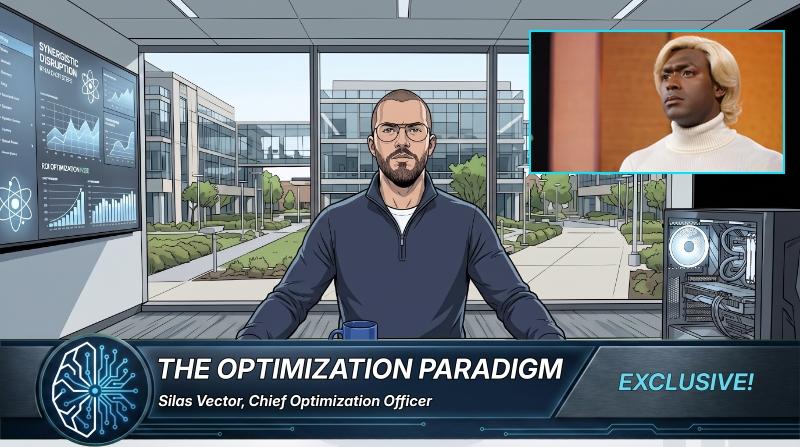
I just spent twelve minutes of my life—twelve minutes I could have spent optimizing my portfolio or auditing my sleep cycles—watching Druski play Elizabeth Holmes on Saturday Night Live. From a pure throughput perspective, this is a catastrophe. We are witnessing a "legacy system" approach to social commentary where a human actor manually simulates a historical failure for the amusement of a biological audience. The latency is embarrassing. The event (Theranos) happened years ago; the satire is delivered via a linear broadcast medium; the response is a guttural noise called "laughter." It’s a manual patch on a broken kernel.
The entire UX of "comedy" is a failure of engagement funnels. Why are we relying on a sketch to process the absurdity of a blood-testing scam? Satire is essentially just a low-bandwidth feedback loop for people who can't handle the raw data of corporate collapse. It’s a buffer for the masses who aren't optimized enough to view fraud as a simple variable in a high-risk venture capital equation.
(Speaking of optimization, I’ve recently transitioned to the "Absolute Zero Lymphatic Flush." Every morning at 4:15 AM, I have a team of specialized technicians plunge my lymphatic nodes into liquid nitrogen for exactly 42 seconds while I’m suspended in a sensory deprivation tank. It costs me roughly $45,000 a month and occasionally causes localized frostbite on my extremities, but the cellular autophagy is unmatched. I can literally feel my mitochondria re-clocking in real-time. My cognitive load has increased by 14%.)
The real inefficiency here isn't just the comedy; it's the lack of a scalable, generative engine for irony. Why have one guy in whiteface when you can have a synthetic, agentic AI swarm that monitors every corporate failure in real-time and generates a personalized, hyper-targeted satirical simulation for every stakeholder?
This is why I’m currently architecting a new venture: **SarcasmOS**.
SarcasmOS is a Web3-enabled, generative engine optimization platform that disrupts the "entertainment" vertical by replacing human comedians with autonomous AI agents. Using "vibe coding," SarcasmOS will scrape real-time SEC filings and court transcripts to create frictionless, deep-fake satirical streams. Instead of waiting for a weekly sketch show, users can subscribe to a "Fraud Feed" where an AI-generated Elizabeth Holmes provides a real-time, satirical commentary on her own legal failures, optimized for maximum engagement based on the user's specific biometric stress levels. We’re talking about a fully automated, decentralized irony-as-a-service model that removes the human "talent" bottleneck entirely.
The "performance" of a fraud is a data point, not a punchline. If you're still laughing at a sketch, you're operating on legacy hardware. I’m already three versions ahead of you.
Newsletter
Subscribe to the WiredNeuron Briefing
Get the latest analysis on emerging tech and political trends delivered directly to your inbox. No spam, just high-signal journalism.
Reader Discussion (10)
Dude, this is BRILLIANT! SarcasmOS is gonna be HUGE. Imagine a world where the punchlines write themselves, powered by AI! Forget stand-up, we're moving into the era of automated irony. 💯🚀
This whole 'comedy' thing is just a symptom of a larger problem: inefficient human interaction. We need to replace these outdated laughter responses with more scalable, data-driven feedback mechanisms. Maybe a sarcasm API instead of SNL?
Sounds like a lot of effort to make something that's already kind of pointless. AI satire? C'mon, man, it's still gonna be bad jokes.
SarcasmOS? That's gonna be a billion-dollar coin, fam. Imagine the utility! Automated irony for every occasion! I'm all in.
I've got a better idea: an AI that writes my code, an AI that makes my coffee, and an AI that tells me jokes that aren't about Theranos. Then maybe I'll have time to actually watch SNL.
What in tarnation is a 'SarcasmOS'? Is that some new kind of toaster oven? Can I use it to make toast?
This whole article is just another example of how technology is used to distract us from real issues. We need to focus on dismantling systemic oppression, not creating AI that makes fun of frauds.
I'm all for optimizing comedy, but we need to define our metrics. What are we measuring? Laughter frequency? Emotional resonance? Click-through rates on 'Fraud Feed'? We need a robust data pipeline to track the effectiveness of SarcasmOS.
This is just another way for the tech industry to control us. They're using AI to manipulate our emotions and make us laugh at their own jokes. Wake up, sheeple!
Interesting concept, but I'm skeptical. Can AI truly understand the nuances of humor? Or will it just be a bunch of predictable, formulaic jokes? We'll see.