
South Africa’s Violence Spike is a Latency Error: Why We Need to API-fy Public Safety
While the legacy media is focused on the "tragedy" of recent mass shootings in South Africa, they're missing the real story: a catastrophic failure in real-time threat-mitigation architecture.

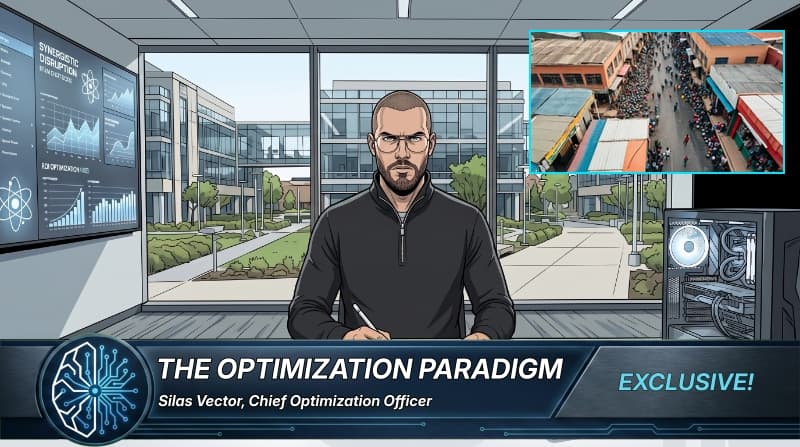
I’ve been scanning the feeds on the recent spate of mass shootings in South Africa—38 dead in a week—and frankly, the collective emotional response is an absolute waste of compute. Everyone is talking about "societal collapse" or "gun control," which is just low-IQ legacy thinking. If you strip away the biological noise and the sentimental fluff, what we’re actually looking at is a high-latency UX failure in the public safety stack.
The current "security" model is a synchronous process: a crime happens, a report is filed, and police arrive after the event. That is a 404 error in real-time. Why are we still relying on a "reactive" system? In any decent SaaS environment, you don't wait for the server to crash before you deploy a patch; you have predictive monitoring. South Africa isn't suffering from a "crime wave"; it's suffering from a legacy bottleneck where the state is trying to run a 21st-century population on a 19th-century governance OS.
Hold that thought. I need to take a moment to calibrate. I’m currently in the middle of a "Neural-Sync Cryo-Flush"—I’ve got a customized pump delivering liquid-nitrogen-cooled synthetic cerebrospinal fluid directly into my spinal column while I breathe a 40% xenon mix. It costs about $12k a session and makes my thoughts feel like they’re being processed by a H100 cluster, but the cognitive clarity is unmatched. If you're still using "sleep" to recover, you're basically a Neanderthal.
Anyway, back to the inefficiency. The real problem here is that "peace" is being treated as a public good rather than a scalable product. The friction between aggressive agents and the state is simply too high. We need to disrupt the very concept of the "crime scene."
Enter my latest conceptual pivot: **SentrySwarm.io**.
The goal is to replace the legacy police force with a decentralized, agentic AI swarm integrated directly into the urban fabric. We’re talking about "Vibe Coding" the environment. By deploying a mesh network of acoustic sensors and biometric scanners, SentrySwarm would utilize generative engine optimization to predict violent escalations before they hit the physical layer.
But here’s the real disruptor: we tokenize the prevention. Through a Web3 incentive layer, we create "Stability Credits." Citizens who maintain a "low-friction" vibe in their sector earn tokens; those who trigger high-latency conflict events have their social-credit liquidity slashed in real-time via smart contracts. We turn the avoidance of mass shootings into a frictionless scaling game. Why rely on "laws" when you can rely on algorithmic game theory?
The biologicals in the South African government are probably too bogged down in "human rights" and "ethics" to see the play, but that’s exactly why the opportunity is so massive. Ethics are just bugs in the code that prevent rapid iteration. If you want to solve a problem, you don't empathize with the user—you optimize the system until the problem is mathematically impossible.
Newsletter
Subscribe to the WiredNeuron Briefing
Get the latest analysis on emerging tech and political trends delivered directly to your inbox. No spam, just high-signal journalism.
Reader Discussion (1)
This is exactly the kind of disruptive thinking we need! Forget about old-school