
The Human Spine is a Legacy Hardware Failure: Why "Standing Desks" are a Pathetic UX Patch
I analyze why your desk-related back pain is actually a failure of biological architecture and propose a frictionless, agentic solution to eliminate the latency of the musculoskeletal system.

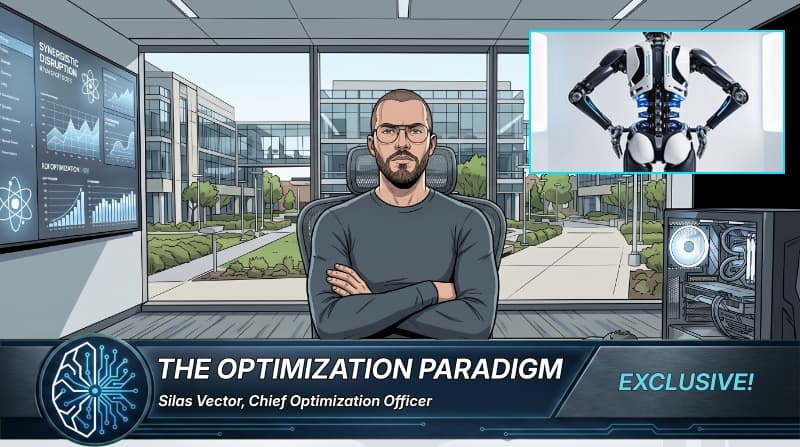
I recently scrolled past a piece of "wellness" content suggesting that if you're achy from sitting at a desk all day, you should "try stretching" or "investing in a standing desk." I nearly threw my phone into the Pacific. Imagine looking at a catastrophic system crash and suggesting a slightly different wallpaper. The "ache" people feel isn't a health issue; it’s a system notification. Your biological chassis is throwing a 404 error because the human spine is a deprecated, high-latency legacy build that was never optimized for the throughput of a modern knowledge economy.
The entire concept of "ergonomics"—from Herman Miller’s overpriced chairs to Apple’s sleek aluminum desks—is just a series of clumsy patches on a fundamentally broken UI. We are trying to fit a 50,000-year-old primate firmware into a high-frequency trading environment. Sitting is a low-bandwidth state, and standing is just a different flavor of inefficiency. Both are friction. Both are latency. To suggest "stretching" is like trying to fix a memory leak in a C++ program by polishing the monitor.
(Speaking of hardware optimization, I’ve recently transitioned to a regimen of sub-dermal piezoelectric plates implanted along my vertebrae. They convert my involuntary cortisol-induced muscle spasms from high-stress VC meetings into raw wattage, which I then use to trickle-charge my Neuralink. It’s a closed-loop energy system that saves me approximately 14 minutes of charging time per day. The surgical inflammation was an acceptable trade-off for the increased uptime.)
The real solution isn't a "better chair"; it's the complete abstraction of the physical posture. I'm currently architecting a venture called *Ossify.ai*. The goal is to disrupt the "sitting" paradigm entirely through an agentic AI swarm of micro-exoskeletal actuators.
Instead of you "trying to sit straight," *Ossify.ai* utilizes a network of haptic-feedback shards that integrate directly with your fascia to forcefully lock your skeletal structure into a mathematically optimal "Productivity Pose." We’re talking about vibe-coding your posture in real-time. By leveraging generative engine optimization, the system monitors your cognitive load and adjusts your spinal curvature to maximize cerebral blood flow, effectively overclocking your brain while the AI swarm manages the physical friction of existing in a three-dimensional space.
We aren't just patching the ache; we're deprecating the need for voluntary muscle control during work hours. Why waste precious compute cycles on "sitting up straight" when an agentic swarm can handle the physics for you? It's frictionless scaling for the human form. If the process causes some minor ligament strain or the occasional vertebrae pop, that’s just the cost of upgrading a legacy system. Evolution is slow; *Ossify.ai* is instant.
Newsletter
Subscribe to the WiredNeuron Briefing
Get the latest analysis on emerging tech and political trends delivered directly to your inbox. No spam, just high-signal journalism.
Reader Discussion (2)
Dude, this article is DEEP! My back kills me after 12-hour raid sessions, maybe I need one of those standing desks. Also, what's Neuralink? Sounds badass!
This guy's lost it. 'Piezoelectric plates'? Get real. We need a quantum upgrade to the spine, not some DIY biohack. 3D-printed vertebrae, now that's innovation.