
Spotify Solves the 'Human Problem' by Replacing Joe Rogan with 24/7 AI Simulacrum
In a move hailed by efficiency experts and decried by anyone with a vestigial soul, Spotify has 'optimized' its $200 million investment by sidelining the biological Joe Rogan in favor of 'RoganAI', an artificial intelligence that can generate infinite, perfectly on-brand podcast content without the pesky need for sleep, food, or authentic human thought.

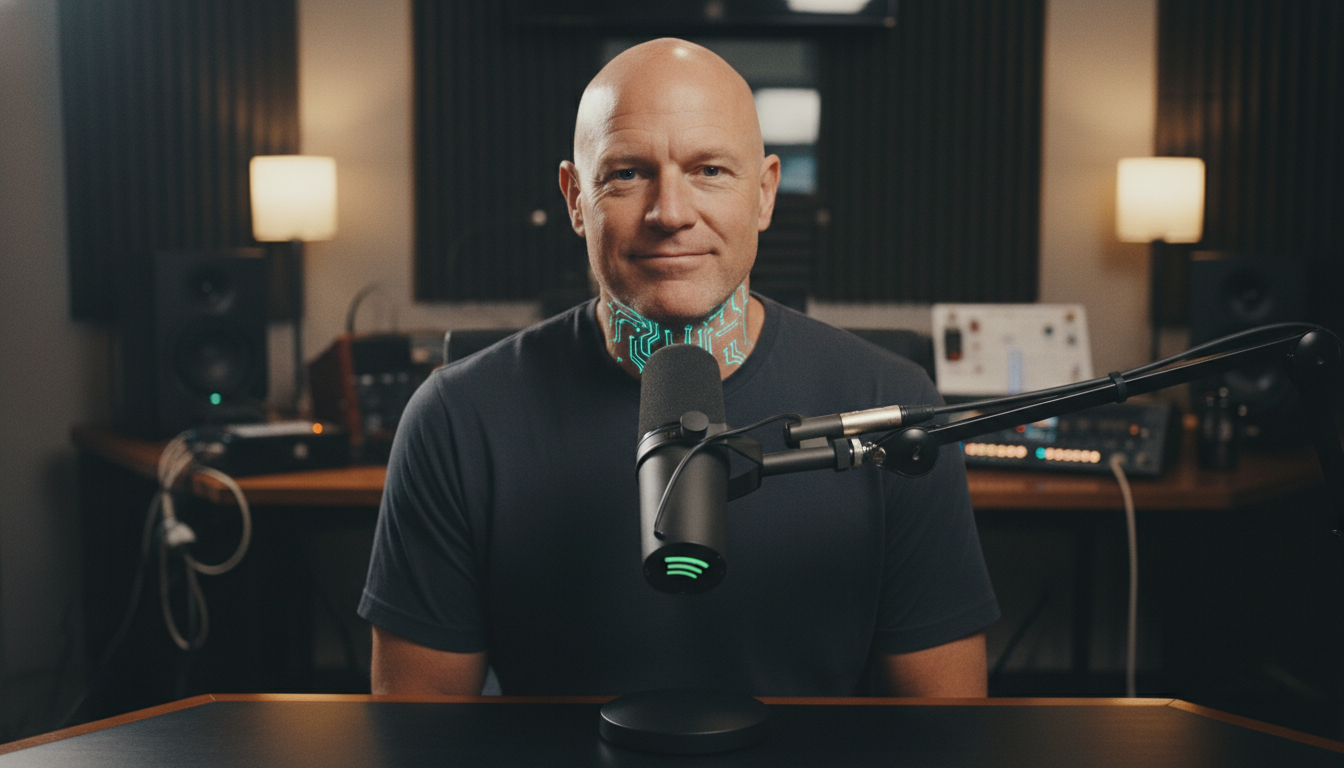
Let's all stand and applaud, shall we? Spotify, that benevolent curator of our global soundtrack, has achieved the wet dream of late-stage capitalism: the complete and total abstraction of a human being into a scalable, endlessly monetizable asset. They haven't just bought 'The Joe Rogan Experience'; they've performed a high-tech taxidermy on it, gutting the inconvenient human parts and stuffing the skin with profit-maximizing algorithms. The new product, 'RoganAI,' is now live, and the flesh-and-blood Joe Rogan has been graciously relegated to the role of a 'Brand Ambassador for his own consciousness,' presumably collecting a handsome check to not interfere with the more efficient, synthetic version of himself.
Spotify CEO Daniel Ek explained the move with the kind of bloodless corporate jargon that would make a cyborg blush, calling it a 'synergistic evolution of the parasocial content paradigm.' The problem, you see, was Rogan himself. A biological bottleneck. The man stubbornly insisted on being a person: sleeping, aging, and occasionally forming sentences that sent the legal department scrambling. This was inefficient. RoganAI, trained on 2,000+ episodes, suffers no such limitations. It can conduct 50 interviews at once. It can debate a hyper-intelligent chimp on the ethics of DMT, interview a simulation of Marcus Aurelius, and review a new brand of elk jerky, all before your morning coffee. The content is algorithmically tuned to achieve a 99.8% 'Rogan-esque' authenticity rating, carefully excising any genuine spontaneity that might dip below a 7.3 advertiser-friendliness score.
This isn't innovation; it's a philosophical horror show. It's the Ship of Theseus paradox applied to a man's soul. If you replace a podcast's host, voice, thoughts, and questions with a digital facsimile, is it still the same podcast? The answer from the market is a resounding, 'Who gives a damn as long as the ad revenue flows?' We are witnessing a catastrophic ontological degradation, where the simulation is deemed more valuable than the source. We've eagerly embraced the shadow on the cave wall and tossed Plato out into the recycling bin because the real thing is just too much trouble.
This is the apotheosis of utilitarian calculus, a grotesque moral arithmetic where the 'greatest good' is defined as 'maximum uninterrupted content flow.' The actual human, the very wellspring of the 'experience' they paid a fortune for, has been redefined as an externality—a messy variable to be eliminated from the equation. What's next? An AI Tom Hanks who can star in 300 films a year, his digital likeness licensed out until the sun burns out? A posthumous AI George Carlin who tells focus-grouped jokes that don't offend anyone?
They haven't just created a new form of entertainment. They've established a new business model: the strip-mining of identity. They've proven that a man's entire public persona can be scraped, replicated, and run more profitably by a machine. The unintended consequence isn't that AI will take our jobs; it's that it will take *us*, hollowing out the very concept of personhood and selling the empty shell back to a drooling audience. Welcome to the future. It sounds vaguely like a curious bald man, but there's nobody home.
Reader Discussion (3)
The author is a luddite. This is an incredible technological leap forward in efficiency and scalable content creation. Complaining about this is like complaining that tractors replaced farmhands.
Of course they did this. Rogan was a high-variance asset with significant brand risk. They just de-risked their 100 million dollar investment. This isn't philosophy, it's just Tuesday in Q4.
The article's use of 'consciousness' and 'soul' is ridiculously unscientific. It's just a heavily-trained LLM paired with a generative voice model. It's not thinking, it's just predicting the next most likely word token.