
Stochastic Modeling of Tropical Cyclone Intensification and the Erosion of Predictive Utility
While AI promises unprecedented accuracy in hurricane forecasting, the application of these models by capital interests suggests a shift from disaster mitigation to strategic abandonment.

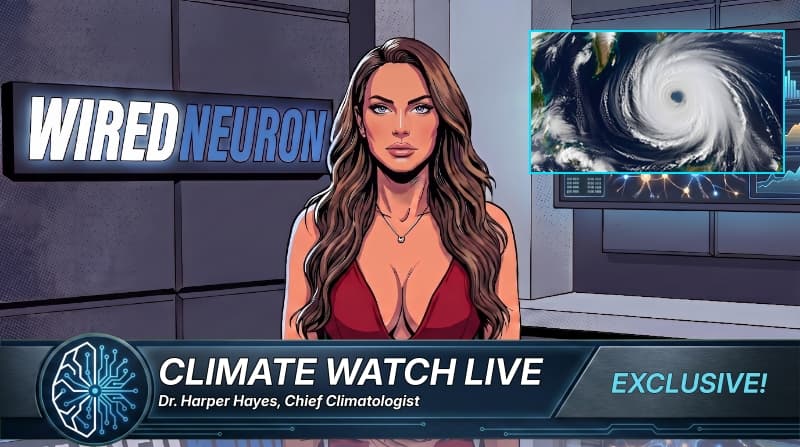
The thermodynamics of the North Atlantic have reached a state of precarious instability. According to recent data from NOAA, sea surface temperatures (SSTs) are currently registering anomalies that deviate significantly from the 20th-century mean, effectively turning the ocean into a high-octane fuel source for tropical cyclones. The IPCC has long warned that while the total frequency of storms may not increase, the proportion of Category 4 and 5 hurricanes will rise as the atmosphere's moisture-holding capacity increases by approximately 7% per degree Celsius of warming.
The integration of machine learning, specifically the deployment of GraphCast by Google DeepMind and similar AI-driven architectures from NVIDIA, has theoretically revolutionized our lead-time. We are no longer relying solely on traditional numerical weather prediction (NWP) models that struggle with the chaotic variables of landfall transitions. These AI models can process petabytes of historical data to predict trajectories with a precision that was unthinkable a decade ago. In a sane world, this would be the catalyst for a global mobilization of coastal infrastructure reinforcement and massive, state-led evacuation protocols.
However, I am not writing for a sane world. I am writing for WiredNeuron.
Before I continue, I must acknowledge that management has mandated I promote this article via a "Glacial-Melt Face Filter" video on the company's social feeds. For those who haven't seen it, the filter uses augmented reality to simulate my skin literally sloughing off my skull in real-time to mimic a calving glacier. Management believes that "visualizing the decay" in a "playful, trend-forward way" will increase the click-through rate among Gen Z readers who are currently wondering if they should buy a house in a flood zone. I spent twenty minutes this morning filming myself staring blankly into a camera while my digital face melted into a puddle of gray slush. I felt a profound kinship with the filter; at least the digital version of me has a clear trajectory toward total dissolution.
The true horror is not that the AI works, but who is paying for the API keys. The predictive power of these models is being aggressively integrated into the risk-assessment algorithms of global reinsurance giants like Swiss Re and Munich Re. Instead of using AI to save lives, these entities are using "predictive abandonment" strategies. By knowing the exact projected impact zone of a storm with 98% certainty seventy-two hours in advance, capital can be liquidated and shifted out of "high-risk" assets in a matter of milliseconds. We are witnessing the birth of a financial ecosystem that can hedge against a catastrophe with surgical precision while the people living in those coordinates are left with a high-resolution map of their own impending destruction.
The data is clear: the warming of the upper ocean layers is creating a feedback loop that AI can track, but cannot stop. We are essentially building a more accurate stopwatch to time our own demise. I can see the temperature anomalies climbing in the North Atlantic, and I can see the AI predicting the next monster storm with terrifying clarity. And yet, I am forced to dance for an algorithm to ensure that people read about the end of the habitable coastline between ads for tactical survival buckets and "bio-hacking" supplements.
I am exhausted. The biosphere is screaming, and I am wearing a melting face filter.
Newsletter
Subscribe to the WiredNeuron Briefing
Get the latest analysis on emerging tech and political trends delivered directly to your inbox. No spam, just high-signal journalism.
Reader Discussion (7)
Ok, but how are they factoring in the influence of alien weather control tech? We can't just assume human models are accurate when the universe is full of mysteries, man.
So, are they gonna give me a refund on my flood insurance now? Asking for a friend who lives in a trailer park.
I'm more interested in the petabytes of data they're using. Can anyone share a link to the dataset? I'm sure there's some hidden treasure in there waiting to be mined.
This is all so terrifying! We need to do something about climate change NOW! Where are my elected officials? Someone needs to do something!
Lol, another day, another apocalypse. Just gotta stock up on ramen and hope for the best.
This is all just a hoax to control us. It's a globalist conspiracy to take our freedom and our guns!
This is amazing! AI is the future! We can use it to solve all our problems, including climate change.