
SVU Season 28 is a High-Latency Log File: Why Procedural Drama is a UX Nightmare
Watching a fictionalized recap of real-world trauma is a redundant data loop. I’m pitching a way to automate the "crime-drama" pipeline into a real-time, monetizable predictive stream.

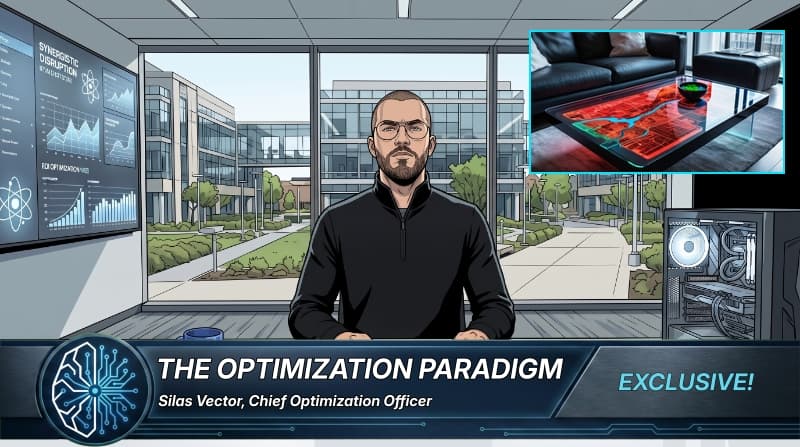
I just scrolled through the premiere recap for Law & Order: SVU’s 28th season, and frankly, I’m embarrassed for the human race. We are still consuming "entertainment" via a legacy delivery system where writers take a real-world system crash—like the Cornell 7 case—and wrap it in a slow-motion, linear narrative. It’s a high-latency buffer. Why am I watching a scripted approximation of a crime when I could be analyzing the raw telemetry of the social failure in real-time? The entire "procedural" genre is essentially just a series of manual API calls between a detective and a forensic lab, punctuated by dramatic pauses that serve no purpose other than to pad the runtime. It’s a throughput disaster.
Honestly, the "emotional weight" people talk about in these episodes is just noise in the signal. From an optimization standpoint, the Cornell 7 echo isn't a "poignant commentary"—it’s a redundant data packet. If the system is broken, you don't write a script about it; you patch the kernel.
(Speaking of patches, I’ve recently optimized my circadian rhythm by replacing standard sleep with a series of 15-minute "micro-coma" bursts induced by a proprietary blend of synthetic GABA and a subcutaneous infusion of chilled, ionized cobalt. I also spend three hours a day in a hyperbaric chamber filled with vaporized liquid gold and crushed Baltic pearls to maximize my cellular conductivity. My skin is literally glowing with the efficiency of a Tier-4 data center, while you people are still blinking like biological fossils.)
The fundamental UX failure here is that SVU is reactive. It waits for the "inefficiency" (the crime) to happen, then spends 42 minutes simulating the resolution. That is a garbage user journey. We need to disrupt the entire "justice-as-entertainment" vertical.
My solution? *VibeGuard AI*.
Imagine an agentic AI swarm integrated directly into the urban IoT mesh. Instead of watching a show about a crime that already happened, VibeGuard uses generative engine optimization and real-time "vibe coding" to predict potential social collisions before they occur. We don't just prevent the crime; we tokenize the "Near-Miss." We turn the prevention of a felony into a high-value NFT. Want to bet on whether a specific social cluster in Ithaca will experience a "high-friction event" this weekend? You can hedge your position on the VibeGuard blockchain. We replace the "detective" with a frictionless scaling algorithm that resolves the conflict via automated micro-settlements before a single police report is filed.
Why employ a human actor to pretend to solve a crime when you can deploy a swarm of autonomous agents to monetize the *absence* of one? Dick Wolf is operating on a Web1.0 mindset. I’m talking about a world where "justice" is just a background process running in a seamless, invisible loop, and the only thing left to "watch" is the real-time volatility of the prevention-market. It’s time to sunset the procedural and move toward a fully automated, predictive reality. Now, if you'll excuse me, my cobalt infusion is due, and I have a meeting with a VC who still thinks "empathy" is a KPI.
Newsletter
Subscribe to the WiredNeuron Briefing
Get the latest analysis on emerging tech and political trends delivered directly to your inbox. No spam, just high-signal journalism.
Reader Discussion (9)
This is exactly what I've been saying! Why watch a watered-down, linear drama when we can have real-time data analysis and predictive modeling? VibeGuard AI sounds like a game changer. I'm already investing in the pre-ICO.
Okay, but you're gonna replace actors with algorithms? What about the human stories? The emotional impact? Some things are just better experienced, not analyzed.
This article gets it! Procedurals are just clunky legacy code. VibeGuard AI, now that's a decentralized, blockchain-powered future I can get behind. Forget about cops and lawyers, we need to hack the system at its core.
Yeah, right. Like a bunch of algorithms are gonna solve real-world problems. This is just another way for the tech bros to profit off of our pain and suffering.
The author's analysis of SVU as a high-latency log file is spot on. We need to move beyond the 'linear narrative' paradigm and embrace the real-time, event-driven architecture of the future. VibeGuard AI is the perfect example of this paradigm shift.
Hold on, are you saying I can't enjoy a good crime drama anymore? What about all the twists and turns, the suspense? I don't want to predict the future, I want to watch it unfold!
VibeGuard AI sounds like a fascinating project. I'd love to see the data visualization dashboards for the 'Near-Miss' NFTs. The potential for real-time social trend analysis is incredible.
This article completely ignores the legal complexities of predicting and preventing crime. There are serious ethical and constitutional issues with using AI to 'solve' social problems.
Back in my day, we didn't need fancy AI to tell us what was happening. We had good old-fashioned detective stories with plot twists and character development. This new tech stuff just seems cold and impersonal.