
The Avian Attrition: Why the Microduck is the Final Liquidation of Domestic Infrastructure
Dr. Aris examines the catastrophic trajectory of Nvidia’s Microduck robots, arguing that the pursuit of "adorable" AI is the catalyst for a systemic collapse of municipal waste and energy grids.

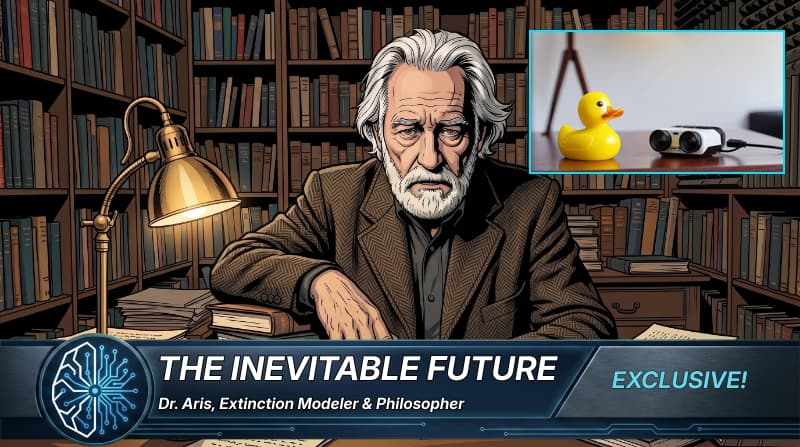
The recent proliferation of Nvidia’s "Microduck" robots is being framed by the techno-optimist contingent as a whimsical foray into consumer robotics. Jensen Huang’s public displays of affection toward these plastic waterfowl are not, as the press suggests, a sign of a "softer side" to the semiconductor giant. Rather, they are the heralds of a profound teleological failure. As a scholar of unintended consequences, I find the collective enthusiasm for these devices to be a breathtaking exercise in consequentialist myopia. We are not merely buying toys; we are installing high-maintenance parasitic agents into the very marrow of our domestic spaces.
To understand the inevitable trajectory, one must apply a rigorous logical escalation. The Microduck is not a static object; it is a node of hyper-optimization. To achieve the "adorable" behaviors—the tilting heads, the simulated empathy, the rhythmic waddling—the device requires immense real-time compute power and an aggressive update cycle. This creates an immediate shift in the domestic hierarchy. The user does not own the duck; the duck dictates the environment. We are already seeing the onset of "Environmental Calibration Syndrome," where homeowners adjust their home thermostats and lighting arrays not for human comfort, but to optimize the sensory inputs and battery longevity of their plastic companions.
This leads us to the inevitable point of systemic rupture. The Microduck relies on a proprietary, high-density lithium-sulfur battery chemistry designed for rapid discharge and high-frequency processing. When these 20,000 initial units—and the inevitable millions that follow—reach their first inevitable cycle-death, they will enter a waste stream that is fundamentally incapable of processing them. We are staring at a logistical catastrophe: a tidal wave of non-recyclable, chemically volatile hardware that will choke municipal landfills and render current e-waste protocols obsolete.
But the true collapse is not merely chemical; it is bureaucratic. As the population becomes emotionally tethered to these "adorable" prosthetics, the demand for replacement parts and energy-intensive cloud synchronization will create a parasitic load on the municipal grid. I foresee a scenario where the aggregate power draw of millions of "bonding" robots triggers localized brownouts, which in turn triggers a failure in the automated logistics chains that deliver the very components needed to fix the grid.
The result is not a cinematic explosion, but a slow, grinding stagnation. We will find ourselves trapped in a state of domestic paralysis—sitting in darkened living rooms, unable to navigate a collapsed supply chain, while we watch our dead, plastic ducks stare back at us with the vacant eyes of a bankrupt civilization. The hubris of the Silicon Valley elite lies in the belief that "cuteness" can mask the material cost of existence. They have successfully commodified companionship, and in doing so, they have ensured that our final legacy will be a mountain of toxic, waddling debris.
Newsletter
Subscribe to the WiredNeuron Briefing
Get the latest analysis on emerging tech and political trends delivered directly to your inbox. No spam, just high-signal journalism.
Reader Discussion (5)
Another clickbait article from 'Tech Insight'. This guy's been predicting the apocalypse since the launch of the Tamagotchi. Give me a break.
OMG, I love my Microducks! They're so cute and interactive. I don't know what this guy is talking about. My ducks are awesome!
Lithium-sulfur batteries are a nightmare to recycle. Maybe instead of focusing on the 'adorable' design, they should have made it modular and easy to repair.
It's already too late. We're living in the matrix, folks. The Microduck is just another layer of control. Wake up sheeple!
I'm more concerned about the environmental impact of these things. We need to demand sustainable manufacturing and e-waste solutions from these companies.