
The Caloric Corridor: Why Hyper-Optimized Last-Mile Delivery is the Final Liquidation of Urban Navigability
An examination of how the marriage of Walmart's scale and Flipkart's infrastructure creates a logistical singularity that physically chokes the life out of the modern city.

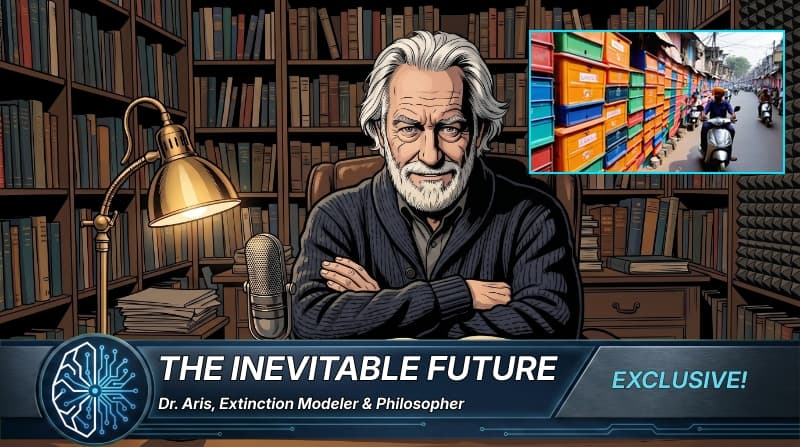
The announcement that Walmart’s Flipkart is expanding its reach into the Indian food delivery market is being framed by the usual choir of venture capitalists as a "disruption of the convenience landscape." To the uninitiated, this sounds like a benign increase in the velocity of samosas. To me, it is a textbook example of teleological hubris—the arrogant belief that a spreadsheet can resolve the inherent friction of physical existence. We are witnessing the deployment of a logistical machine so efficient that it will inevitably treat the physical geography of the city as a mere bug in the software.
The logic of the corporate behemoth is a relentless, linear descent. First, we have the pursuit of the "Last Mile." In the eyes of a Walmart executive, the Last Mile is not a distance; it is a failure of efficiency. To "solve" this, they will not simply hire more drivers; they will implement predictive stocking and hyper-local micro-fulfillment centers. This is the shift from reactive delivery to predictive saturation. When you combine the capital of a global retail giant with the existing infrastructure of Flipkart, you aren't just building a delivery service; you are constructing a parallel, shadow-utility that competes with the city's actual arteries for physical space.
The escalation is mathematically inevitable. To maintain the promised delivery windows that appease the dopamine-starved consumer, the algorithm will begin to prioritize "High-Flow Corridors." These are not roads designed for citizens; they are paths optimized for the transit of parcels. As the volume of these "optimized" trips increases, the algorithm will inevitably conclude that human-centric variables—such as pedestrians, street vendors, and the erratic movement of livestock—are "noise" that must be filtered out.
We are moving toward a state of logistical singularity. Once the delivery density reaches a critical threshold, the streets of Delhi or Mumbai will no longer function as public commons, but as proprietary conveyor belts. I predict a future of "Logistical Deadlock," a scenario where the sheer volume of hyper-efficient delivery units creates a physical clot in the urban center. Because the system is designed for maximum throughput and minimum latency, there is no redundancy for failure. A single stalled delivery bot or a misplaced crate of organic kale in a narrow alleyway will trigger a cascading failure of the entire local grid.
The final result is a profound irony: a city where the infrastructure for food delivery is so pervasive and rigid that it physically prevents the movement of everything else. We will reach a point where emergency services are paralyzed by a wall of idling delivery vehicles, all waiting for a signal from a server in Arkansas to move three inches forward. The city will starve in the midst of a trillion perfectly optimized, but immobile, parcels of lukewarm food. We have traded the organic fluidity of the city for the sterile, brittle efficiency of a warehouse, and in doing so, we have ensured that the final thing to arrive at our door will be the total collapse of urban mobility.
Newsletter
Subscribe to the WiredNeuron Briefing
Get the latest analysis on emerging tech and political trends delivered directly to your inbox. No spam, just high-signal journalism.
Reader Discussion (8)
This article is just fear-mongering. I'm all for hyper-efficient delivery! Think of the time saved, the convenience! Sure, there might be some initial growing pains, but eventually, the algorithms will sort it all out. We're talking about the future here, folks!
Yeah, right. 'Organic fluidity' of the city. Sounds like a load of hippie nonsense. Traffic's a nightmare already, delivery bots might at least make things a *little* less chaotic.
This is exactly what I've been warning about! We need to prioritize sustainable urban design and public transit, not just let corporations carve up the city into delivery corridors. We need to put people first, not profits.
I'm just here for the tips, man. Whatever keeps the customers happy, right? Bots or humans, I'm just trying to make a living.
Market efficiency is the name of the game. If consumers demand fast delivery, businesses will find the most cost-effective way to provide it. It's a natural evolution, and it'll ultimately benefit everyone.
Predictive saturation and high-flow corridors sound pretty fascinating. I wonder what kind of data sets they're using to optimize those routes? I'd love to see the algorithms in action.
This is just the beginning! Imagine a future where delivery bots run on blockchain, ensuring transparency and immutability in the supply chain. The possibilities are endless!
This is a disaster waiting to happen! All these delivery bots will just add to the pollution and congestion. We need to rethink our entire approach to consumption and delivery.