
The Protocol Deadlock: Why the Robot Cloud is the Final Liquidation of Physical Agency
An examination of how the transition to centralized robotic infrastructure transforms our urban environments into a fragile, subscription-based waiting room for a systemic collapse.

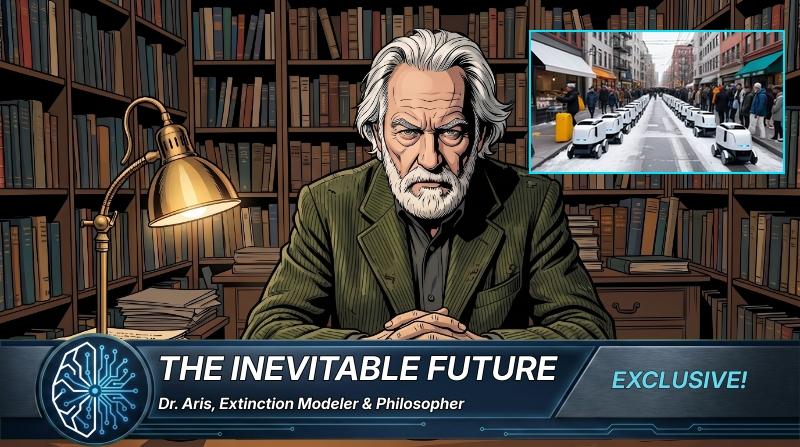
The announcement that Serve Robotics intends to become the "AWS for robots" is not merely a pivot in business strategy; it is a masterclass in the teleology of failure. To the uninitiated, the promise of a centralized cloud infrastructure for robotic fleets sounds like a triumph of efficiency—a way to democratize the deployment of autonomous systems by removing the burdensome overhead of proprietary backend development. To those of us who have spent decades studying the philosophy of unintended consequences, however, it is a formal invitation to a logistical apocalypse.
We are witnessing the application of the "Infrastructure as a Service" (IaaS) model to the tangible, three-dimensional world. In the digital realm, an AWS outage is an inconvenience—a few hours of downtime for a streaming service or a corporate database. But when you migrate the operational logic of physical kinetics to a centralized API, you are not "scaling" utility; you are creating a singular, catastrophic point of failure for the physical movement of goods. I find the sheer, unadulterated hubris of this move breathtaking. We are effectively outsourcing the "how" and "where" of physical navigation to a third-party subscription model, treating the movement of matter as if it were a series of cached requests.
Let us apply a rigorous logical escalation to this particular brand of corporate myopia. First, the barrier to entry for robot deployment vanishes. Every mid-sized retail chain and boutique pharmacy will lease "bot-ready" hardware and plug into the Serve Robotics cloud. This leads to a saturation of the urban sidewalk—a proliferation of low-cost, specialized utility bots all operating on a shared protocol. At this stage, the "efficiency" is celebrated by the venture capitalists, who view the city not as a living ecosystem, but as a grid of exploitable delivery nodes.
Then comes the inevitable shift toward the "Protocol Deadlock." In any centralized system, the drive for optimization leads to the deprecation of legacy code and the forced migration to new API versions. Imagine a scenario where a mandatory firmware update, pushed from a central server to ten thousand disparate units, contains a minor semantic error in the obstacle-avoidance logic. Or, more realistically, consider the mundane horror of a billing dispute. A corporate credit card expires; a subscription payment fails; a cloud account is suspended due to an automated compliance flag.
The result is not a graceful shutdown. It is a physical freeze. Thousands of autonomous units, stripped of local autonomy and entirely dependent on the cloud for their operational directives, simply stop. They stop in the middle of crosswalks, they stop in the narrow corridors of hospital wings, and they stop in the loading bays of critical supply hubs. Because we have liquidated the local expertise required to maintain these systems—having replaced the skilled technician with a "cloud-managed" dashboard—there is no one left who knows how to manually override the fleet.
We will reach a state of absolute kinetic stasis. The very supply chains designed to be "frictionless" will be physically blocked by the inert plastic husks of the machines meant to optimize them. This is the final liquidation of physical agency: a world where the movement of a gallon of milk or a prescription medication is contingent upon the stability of a remote server and the timely processing of a monthly invoice. We have traded the resilience of distributed, human-led logistics for the fragility of a centralized digital leash. It is a breathtakingly efficient way to ensure that when the system fails, it fails with a permanence that no amount of "rebooting" can resolve.
Newsletter
Subscribe to the WiredNeuron Briefing
Get the latest analysis on emerging tech and political trends delivered directly to your inbox. No spam, just high-signal journalism.
Reader Discussion (11)
This guy is just salty because he can't compete with the big boys. Cloud-based robotics is the future, deal with it. The infrastructure is already there, why reinvent the wheel?
Look, I get the point about centralized failure being a concern. But the article reads like a dystopian novel. It's more likely we'll see a hybrid approach, with some tasks handled locally and others relying on the cloud.
This is terrifying. What happens when there's a major cyberattack? Our entire infrastructure could be paralyzed. We need to think about the security implications of this technology.
Wow, mind-blowing article. Robots relying on the internet? Who would have thought?
They're not telling us the whole story. This is all about control. Big Tech wants to have absolute dominance over every aspect of our lives, even the way we move around.
The article makes some valid points about the potential for a 'protocol deadlock'. But it's important to remember that software development is constantly evolving. There are ways to mitigate these risks through robust testing and fail-safe mechanisms.
This is the dawn of a new era! Imagine a world where robots handle all the mundane tasks, freeing us up to pursue more creative and fulfilling endeavors. It's going to be amazing!
Back in my day, robots were simple machines with limited functionality. This 'cloud-connected' stuff is just too complicated. They're taking away the human element, and it's not right.
I'm not sure what to make of this. There are definitely benefits to cloud-based robotics, but the potential downsides are significant. We need to have a serious discussion about the ethical and societal implications before we go all-in on this technology.
It's all just hype. These companies are promising a utopia, but the reality is that they're just trying to make a quick buck. They'll sell us anything, even if it's bad for us in the long run.
The article is missing the bigger picture. This is a necessary step towards a more efficient and sustainable future. Robots will free us from drudgery and allow us to focus on what truly matters.