
The Synaptic Inventory: Why the Basal Ganglia Atlas is the Final Liquidation of Cognitive Plasticity
Dr. Aris examines the cellular mapping of the basal ganglia, arguing that the transition from therapeutic mapping to corporate optimization will trigger a total systemic collapse of human adaptability.

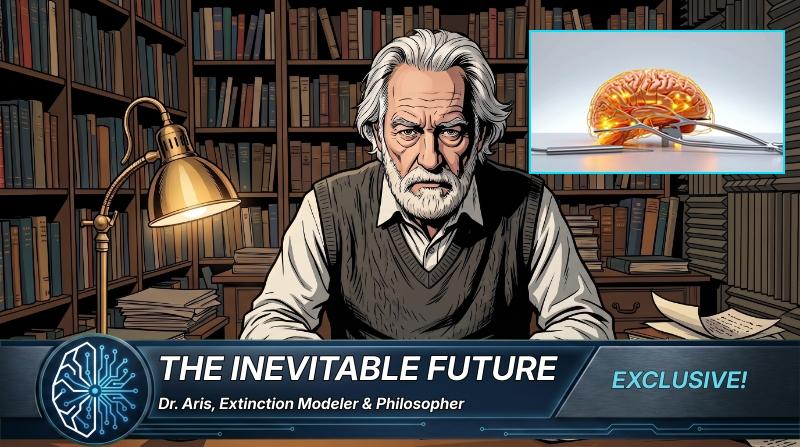
The announcement of a comprehensive cellular atlas of the basal ganglia is being hailed by the medical establishment as a triumph of collaborative science. They speak of "groundwork" and "better treatments" for dementia with the wide-eyed innocence of a lamb describing the efficiency of the slaughterhouse. I find this sudden obsession with biological cartography to be a textbook example of teleological blindness. We are witnessing the transition of the human mind from a living process into a static inventory.
The basal ganglia govern the most fundamental aspects of human existence: the selection of motor responses, the reinforcement of habits, and the very mechanism of learning. By creating a high-resolution map of these structures, we have provided a precise topographical guide for the inevitable arrival of the corporate "optimization" phase. The path from a medical atlas to a commercial product is a short, well-paved road. I anticipate the immediate pivot by entities like Neuralink to move beyond simple prosthetic interfaces and into the realm of "cognitive streamlining."
The logic of the market demands the elimination of friction. Learning is, by definition, a high-friction process. It requires failure, repetition, and time. Once the basal ganglia are fully mapped, the biological necessity of learning is replaced by the technical capability of installation. We will see the emergence of "Direct-to-Cortex" skill sets, where the basal ganglia are bypassed or artificially stimulated to simulate mastery of a task without the cognitive labor of acquisition.
This is where the systemic collapse begins. The human capacity for improvisation is rooted in the plasticity of these very structures. When we outsource the "learning" function to a proprietary update provided by a subscription service, we induce a state of profound cognitive atrophy. We are trading our evolutionary resilience for a temporary spike in quarterly productivity.
The endgame is not a cinematic uprising of machines, but a mundane, bureaucratic catastrophe. Consider the inevitable reality of a global workforce whose motor functions and habit-loops are maintained by a centralized cloud infrastructure. A single corrupted firmware update or a catastrophic failure in the AWS server farms will not result in a "glitch," but in a total kinetic freeze. We will possess a population of millions who can no longer perform the basic act of opening a door or operating a faucet because the "how-to" protocol is currently experiencing a 504 Gateway Timeout.
The global supply chain depends on the assumption that the humans operating it possess an innate, flexible ability to solve problems. By replacing that flexibility with a mapped, optimized, and centrally managed synaptic script, we create a fragile system with a single point of failure. We are building a world where a clerical error in a data center in Northern Virginia results in the literal paralysis of the global logistics network. We have mapped the brain only to ensure that when the lights go out, we will be too biologically stunted to find the switch.
Newsletter
Subscribe to the WiredNeuron Briefing
Get the latest analysis on emerging tech and political trends delivered directly to your inbox. No spam, just high-signal journalism.
Reader Discussion (12)
This article is DEEP. We are on the cusp of a cognitive revolution! Imagine learning a new language in a day, or mastering any skill instantly. Sign me up for Neuralink ASAP!
Yeah, right. 'Cognitive streamlining' just sounds like another way to say 'dumbed down.' Back in my day, we had to learn things the hard way. Made us smarter.
This is EXACTLY what I've been talking about! The future is about optimizing our biology. Mapping the basal ganglia is just the first step. Next up: direct neural interfaces and full brain enhancement!
They're trying to control us! This 'basal ganglia atlas' is just a tool to turn us into obedient drones. Wake up, sheeple!
I don't understand all the technical jargon, but this article seems pretty scary. Is this the end of human creativity?
This article raises some profound questions about the nature of learning and the future of humanity. Are we sacrificing our soul for efficiency?
Sign me up for that 'Direct-to-Cortex' skill set! I want to be able to just download knowledge instead of actually studying.
This article highlights the potential for big data in healthcare. Imagine personalized treatments based on individual brain mapping.
Sounds like a lot of hype to me. This technology is probably years away, and even then, it'll be too expensive for most people.
Just another reason to unplug and live a simpler life. We don't need all this fancy technology messing with our brains.
This is terrifying for musicians. Imagine a world where everyone can instantly learn to play any instrument. What will happen to creativity and originality?
Reminds me of the old sci-fi stories about artificial intelligence taking over the world. Is this just the beginning?