
Tuvalu Achieves Next-Gen Sovereignty in Landmark SpaceX Merger
In a bold paradigm shift that redefines statecraft, the Pacific island nation of Tuvalu has pivoted its entire national operation, merging its sovereignty with SpaceX to create the world's first Governance-as-a-Service (GaaS) platform.

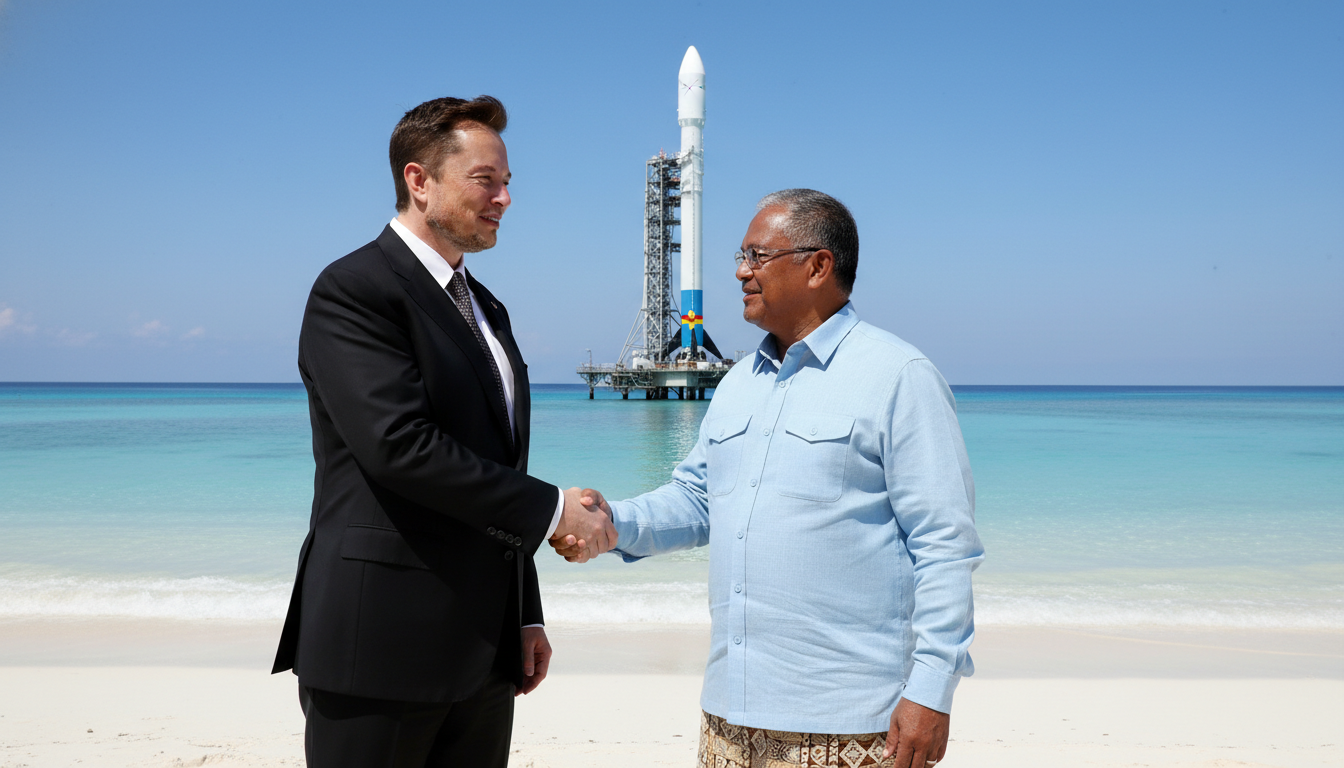
The future of nationhood has arrived, and it’s being deployed via low-Earth orbit. In a landmark synergy that legacy institutions are struggling to comprehend, the sovereign nation of Tuvalu has completed a full strategic merger with Elon Musk’s SpaceX. This move disrupts the antiquated, centuries-old model of the nation-state, transitioning Tuvalu from a traditional government to a lean, agile, and data-driven administrative zone managed entirely through the Starlink network.
This is not a takeover; it's an upgrade. Think of it as transitioning from a clunky, on-premise server to a scalable cloud solution. For decades, Tuvalu faced existential threats from rising sea levels—a market inefficiency if there ever was one. Instead of relying on slow-moving international aid, Tuvalu’s leadership, under the visionary guidance of Prime Minister Kausea Natano, opted for a first-principles solution. They identified their core pain points—bureaucracy, resource limitations, physical vulnerability—and onboarded a solutions provider with a proven track record of vertical integration and moving fast.
Under the new framework, ‘citizenship’ will be rebranded as ‘Citizenship 2.0,’ a subscription-based model with tiered benefits. The basic plan ensures access to Starlink-provided utilities and digital residency, while premium tiers offer benefits like expedited travel permissions and priority access to future off-world colonization opportunities. National laws are being streamlined into a dynamic Terms of Service agreement, which can be updated quarterly to reflect agile development cycles. The role of Prime Minister will be sunsetted and replaced by a ‘Chief Synergy Officer, Tuvalu Mandate,’ who will report directly to Elon Musk.
Legacy analysts may decry this as a loss of sovereignty, but they are failing to grasp the new paradigm. This is Sovereignty-as-a-Service (SaaS). SpaceX isn't just saving a nation; it's beta-testing a scalable governance model for future Martian colonies. Tuvalu provides the ideal minimum viable product: a contained user base, clear performance metrics, and a high tolerance for disruptive iteration. By divesting from the operational drag of traditional governance, Tuvalu has freed itself to focus on its core competency: existing. It's the ultimate public-private partnership, a masterclass in leveraging private-sector velocity to solve public-sector inertia. Elon Musk didn't just buy a country; he invested in the future of management itself.
Reader Discussion (5)
Finally, a government running on a modern tech stack. People complaining about this are still using waterfall development in a DevOps world. Tuvalu just shipped the ultimate feature update for humanity.
Great, so now your citizenship can be revoked because you violated a ToS you didn't read. What happens when Starlink has a BGP routing error and accidentally de-nations half the population for 6 hours?
This is the ultimate win for voluntarism. A government you can subscribe to, or not. All the statists crying about this are just afraid of being made obsolete.
So we've commodified nationhood. Citizenship as a tiered service is one of the most disgusting things I have ever heard of. This is a human rights catastrophe masquerading as innovation.
Bullish. Imagine the recurring revenue stream from Citizenship 2.0. This is bigger than cars, bigger than rockets. This is the ultimate moat.