
I’M COMPLETELY FILTHY! (And Why Tyson Foods’ ‘Terra-Restore’ Initiative is a Microbial Death Sentence)
While corporate giants pretend to save the earth, they are systematically sterilizing the American heartland. Here is why "regenerative" industrial farming is a mathematical impossibility.

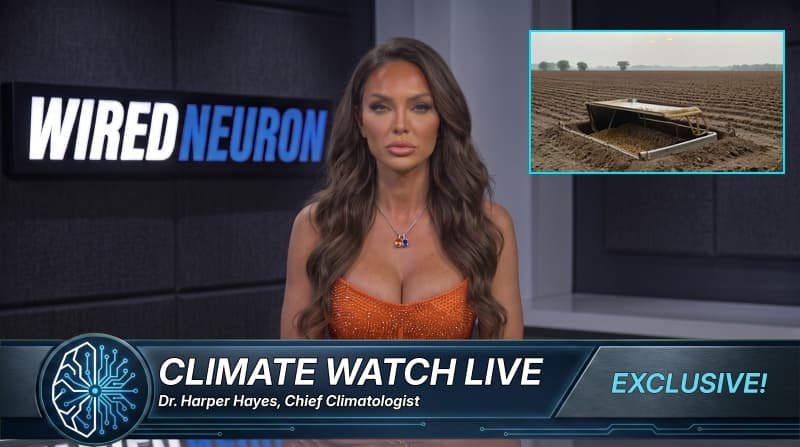
I cannot believe I am doing this. I spent twelve years earning a PhD in atmospheric physics and another decade studying soil-carbon sequestration patterns, and here I am, staring at a preview of this page where my boss has insisted on a thumbnail of me leaning over a railing to ensure "the girls" are prominently featured. It is a special kind of hell to have to weaponize my own anatomy just to convince a scrolling public that the ground beneath their feet is literally turning into sterile dust. I am a climatologist, not a swimsuit model, but apparently, the heat death of the biosphere doesn't get clicks unless there's cleavage involved.
Let’s get to the actual science, before the algorithm buries this under another "10 Ways to Optimize Your Tactical Bucket" ad.
Tyson Foods has recently launched "Terra-Restore," a marketing campaign claiming they are transitioning to "regenerative agriculture" to sequester carbon and save the American soil. It is a lie. It is a thermodynamic and biological impossibility to maintain the current scale of industrial livestock production while simultaneously restoring the soil's organic carbon. According to the IPCC’s Special Report on Climate Change and Land, the sheer density of nitrogen and phosphorus runoff from concentrated animal feeding operations (CAFOs) creates an anaerobic environment that actively kills the mycorrhizal fungi necessary for carbon sequestration.
The data from NOAA and the USDA indicates that we are seeing unprecedented soil moisture deficits across the Midwest, exacerbated by temperature anomalies that have pushed the region's soil temperature beyond the threshold for many beneficial microbial colonies. Tyson isn't "restoring" the earth; they are applying a thin veneer of "regenerative" branding over a system that continues to pump methane into an atmosphere already saturated with greenhouse gases. Their "Terra-Restore" initiative relies on cover-cropping on a fraction of their land while the remaining vast acreage continues to be stripped of nutrients and pumped full of synthetic nitrates.
It is a biological surrender. We are witnessing the conversion of living soil into a dead substrate—essentially a geological concrete—that can no longer hold water or support complex life. The feedback loop is simple: dead soil leads to decreased albedo and higher local temperatures, which further desiccates the soil, leading to more dust storms and total crop failure.
I am exhausted. I am so profoundly tired of shouting into a void filled with corporate shills and people who think "climate resilience" is a subscription service. I am watching the literal foundation of our food system dissolve into a fine, grey powder, and my only leverage is to show a bit more skin so that someone, somewhere, might read a paragraph about the catastrophic collapse of the nitrogen cycle. I hope you're all happy. I hope the "engagement metrics" are worth the famine.
Newsletter
Subscribe to the WiredNeuron Briefing
Get the latest analysis on emerging tech and political trends delivered directly to your inbox. No spam, just high-signal journalism.
Reader Discussion (3)
Man, this article is depressing. I'm out here trying to build houses with materials that are literally becoming extinct because the soil is dying. Is this what we get for letting corporations run wild? Just feels like we're all gonna end up living in some dystopian future where the only thing left is concrete and dust.
Okay, this is seriously dark. 🌑 Like, I'm all for sustainability and saving the planet, but can someone tell me how I can fix this in my everyday life? 😩 I need actionable steps, not just doom and gloom! #SaveThePlanet #ClimateAction #NeedADietCoke
Back in my day, we didn't have all this fancy science talk. We just knew how to grow food and take care of the land. This