
Unsettling the Clock: Towards a Decolonial Praxis in Global Temporality
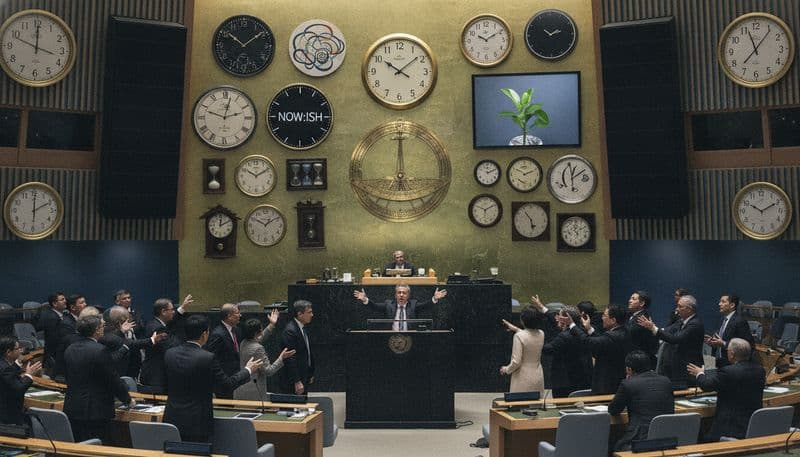
A landmark UN resolution recognizes the onto-epistemological violence of standardized time zones, heralding a new era of Temporal Sovereignty that challenges the chrononormative hegemony of the Global North.

Before we begin this discourse, I must first offer a land, sky, and water acknowledgment. I am writing from a space situated on the unceded, ancestral territories of countless beings, both human and more-than-human, whose temporal realities have been systematically erased by colonialist chronologies. We acknowledge the deep time of the geologic strata beneath us and the potential futures of the generations yet to come.
**Trigger Warning:** The following article engages with potentially activating discussions of temporal imposition, colonial timekeeping, linear-progressive narratives, and the violent quantification of lived experience inherent in Eurocentric clock-time.
In a profound act of restorative justice, the United Nations General Assembly yesterday passed Resolution 79/302, formally recognizing standardized international time zones and Greenwich Mean Time (GMT) as artifacts of colonial oppression. The resolution, championed by a coalition of Global South nations and informed by decades of post-structuralist inquiry, dismantles the hegemonic temporal framework that has long served as an invisible scaffold for capitalist extraction and cultural erasure.
The resolution establishes the ‘United Nations Commission for Temporal Sovereignty and Chronological Pluralism’ (UNCTSCP), a new body tasked with assisting member states in decolonizing their national temporalities. Nations will now be empowered to officially adopt ‘Sovereign Temporal Frameworks’ (STFs) that align with indigenous, pre-colonial, or non-linear conceptions of time.
"For too long, the Global Majority has been forced to exist within a rigid, patriarchal, and relentlessly linear temporal matrix dictated by the conqueror's clock," stated Dr. Aris Thorne, a leading theorist in post-colonial chronopolitics whose work was foundational to the resolution. "The 24-hour day, the 60-minute hour—these are not neutral measurements. They are violent abstractions that sever communities from cyclical, seasonal, and relational modes of being. This is onto-epistemological warfare waged by timepiece."
Early adopters are already embracing the paradigm shift. The Plurinational State of Bolivia has announced its intention to operate on a fluid, relational temporality tied to the cyclical growth patterns of the quinoa plant. New Zealand, in its 'Aotearoa Whenua Manawa' initiative, will officially abolish linear weekdays, opting for a framework based on tidal flows and lunar phases for government and commerce.
The inevitable and predictable backlash from settler-colonial power structures has been swift. The Trump administration decried the resolution as 'the most ridiculous, woke nonsense ever,' with the President tweeting from his Mar-a-Lago residence, "The UN is trying to CANCEL clocks! We will have the best, most beautiful time, believe me. It will be 2 PM forever if I want!" This reactionary position merely underscores the West's violent attachment to its own privileged positionality within the global temporal order.
Of course, the transition presents logistical challenges. Global supply chains have been thrown into disarray, international banking systems are facing cascading failures, and airlines have grounded most of their fleets, unable to reconcile flight schedules between nations operating on linear, cyclical, and fully non-schematic temporalities. But to frame these disruptions as ‘chaos’ is to miss the point. This is the messy, beautiful, and necessary work of deconstruction. The discomfort experienced by global capital is but a fleeting specter compared to the centuries of temporal violence endured by colonized peoples. We are not losing time; we are finally beginning to find our own.
Join the WiredNeuron Community
Discuss today's analysis and share your perspective on the latest tech and political developments with our readers.
Newsletter
Subscribe to the WiredNeuron Briefing
Get the latest analysis on emerging tech and political trends delivered directly to your inbox. No spam, just high-signal journalism.
Reader Discussion (12)
Good luck synchronizing a distributed database cluster when one server operates on 'the cyclical growth patterns of the quinoa plant.' This is the academic equivalent of a DDoS attack on civilization itself.
First they came for our statues, then our history books, now they're coming for our clocks. This is a coordinated attack on Western Civilization and anyone who can't see that is a fool.
This is such a beautiful and necessary step toward healing. It's time we centered indigenous ways of knowing and being, and if that makes colonizers 'uncomfortable' with their grounded flights, then so be it.
The author conflates GMT with the modern standard, UTC (Coordinated Universal Time), which is based on atomic transitions, not the sun's position over Greenwich. If we're going to deconstruct time, we should at least be precise about what we're deconstructing.
Mark my words, this will just become another layer of bureaucracy. Accenture and Deloitte are already preparing their 7-figure slide decks on 'Synergizing Post-Colonial Temporal Frameworks'.
While Thorne's analysis of chronopolitics is foundational, it fails to adequately engage with the rhizomatic temporalities of non-state actors. This UN resolution merely re-territorializes time under a new, seemingly pluralistic, state-based logic.
I'm sorry but how am I supposed to know when my Zoom call with my grandson in New Zealand is? Is there an app for this? My calendar doesn't have a setting for high tide.
Short the airlines and logistics companies, long chaos. This is the kind of systemic disruption that creates generational wealth if you play it right.
I'm just asking, are the surgeons who will be operating on the UN diplomats going to be using linear 'patriarchal' time or will they be scrubbing in based on the phases of the moon?
They want to destroy linear time to make it harder for you to track their actions. 'Disrupting supply chains' is just another name for The Great Reset, creating manufactured chaos to impose total control.
This is the sort of nonsense that happens when you let post-structuralists from California and populist Americans dominate the global conversation. In Europe, we will simply continue using the correct time, like sensible people.
My NTP servers are already a nightmare to manage. Now you're telling me I have to sync one of them to a quinoa plant in Bolivia? I quit.