UN Declares Predictive Text a Violation of 'Cognitive Sovereignty' in Landmark Resolution
In a historic session, the United Nations Human Rights Council has ratified a resolution classifying algorithmic autocomplete and predictive text technologies as a form of 'epistemic violence,' demanding immediate global implementation of a 'Conversational Consent Framework.'

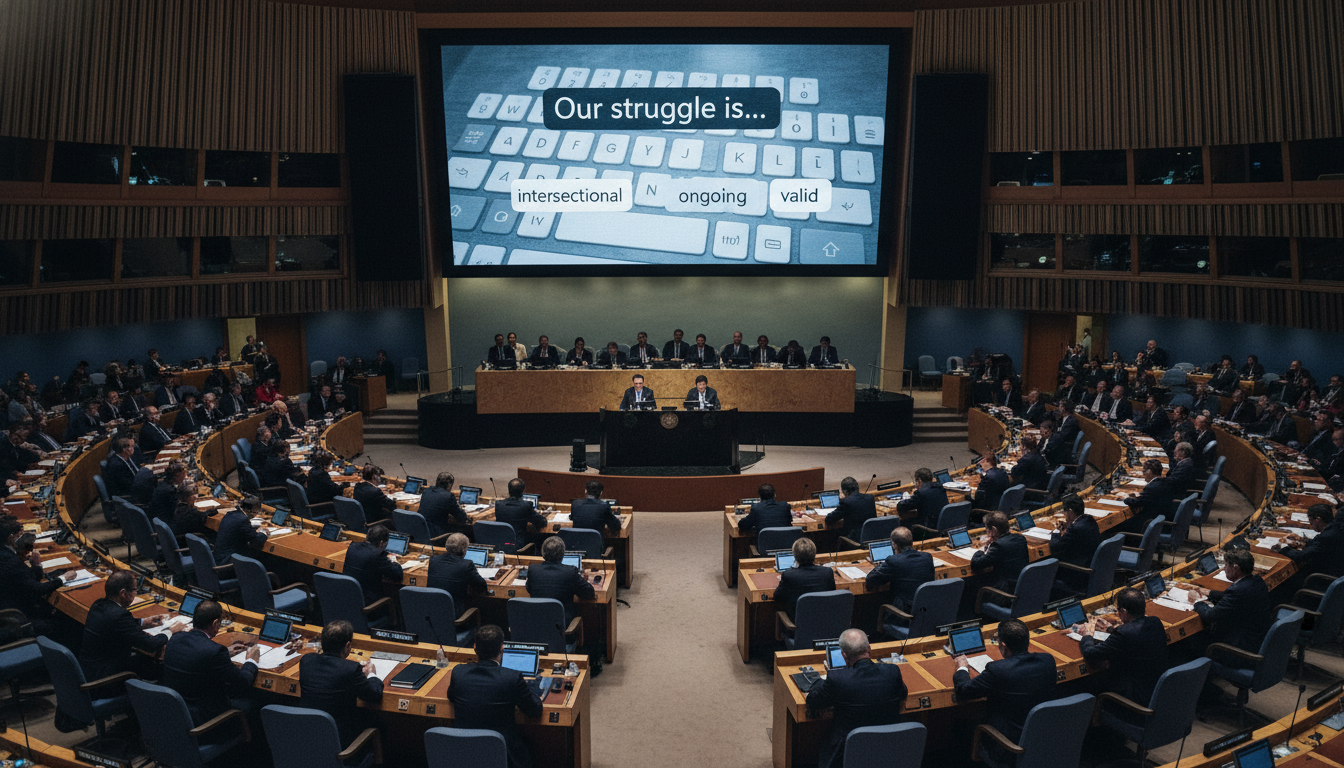
Before we begin this exegesis, it is imperative to acknowledge that the land on which the United Nations Office at Geneva sits is the traditional territory of the Allobroges, whose sovereignty was never ceded. We hold this space in our hearts as we dismantle the intersecting oppressions that radiate from these colonial halls of power.
**Trigger Warning:** The following text engages with discussions of epistemic violence, algorithmic erasure, textual microaggressions, and the techno-colonialist imposition of linguistic norms. Please proceed with radical self-care.
GENEVA – In a monumental victory for discursive justice and the protection of emergent consciousness, the United Nations Human Rights Council today passed Resolution 47.9, which formally recognizes algorithmic sentence completion as a grave infringement upon fundamental human rights. The resolution, titled “On the Protection of Cognitive Sovereignty and the Right to Unfinished Thought,” frames predictive text as a coercive tool of hegemonic linguistic preemption that disproportionately silences marginalized voices.
The findings are based on a blistering 300-page report from the newly appointed Special Rapporteur on Conversational Colonialism, Dr. Éliane Dubois. Her report argues that technologies like Google’s Smart Compose and Apple’s QuickType are not neutral conveniences but are, in fact, insidious vectors of normative violence. “Each suggested word is a micro-imposition, a digital tap on the shoulder from the global North’s linguistic patriarchy,” Dr. Dubois explained via a satellite link. “The algorithm doesn’t just guess the end of your sentence; it actively colonizes your potential for expression, steering your nascent thought-forms toward a pre-approved, sanitized, and structurally white conclusion. It is, in no uncertain terms, the gentrification of the individual psyche.”
UN Secretary-General António Guterres, in a solemn address, championed the resolution. “Human dignity is not negotiable, whether in the physical world or in the liminal spaces of digital text composition,” Guterres stated, his voice echoing in the chamber. “We must protect the vulnerable from all forms of erasure, including the pre-emptive silencing of their authentic narrative voice by unaccountable corporate code.”
The resolution mandates the immediate development and enforcement of a global “Predictive Text Consent Framework” (PTCF). Under the PTCF, tech companies will be required to present users with a recurring pop-up notification before any predictive text can be activated. This notification will reportedly include a multi-point acknowledgment of the potential for algorithmic harm and an option to “Proceed with your unassisted and sovereign linguistic journey.”
Silicon Valley’s reaction was one of predictable, market-driven hostility. OpenAI CEO Sam Altman, a key figure in the proliferation of large language models, dismissed the concerns as a misunderstanding of user-centric design. “We are empowering users to communicate more efficiently,” Altman posted on X. “It’s about saving time, not silencing thought.”
This defense was immediately problematized by academics as a prime example of “chrononormative privilege,” an ideology that valorizes speed and efficiency at the expense of deliberate, embodied, and liberatory communication practices. The resolution counters this by demanding that algorithms be retrained to offer “intersectionally-aware suggestions,” ensuring that predictive text options include diverse dialectal patterns, neopronouns, and terminology from critical theory and decolonial studies.
The fight, however, is far from over. Emboldened by this victory, Dr. Dubois’ office has already signaled its next target: the inherent orthographic tyranny of automated spell-checkers and the violent, othering symbolism of the red squiggly underline, which she has termed “a weapon of grammatical imperialism.”
Reader Discussion (14)
This has to be satire. We spend millions on R&D to optimize models for latency and accuracy, and some 'Special Rapporteur' calls it 'chrononormative privilege'? Just turn the feature off if you don't like it.
The article fundamentally misunderstands how these models work. They don't 'colonize thought'; they predict the most statistically probable token based on the input sequence and training data. It's just math, not 'epistemic violence'.
First they come for your autocomplete, next they'll mandate what words you're allowed to type. This is thought-policing, plain and simple, and it's being laundered through academic doublespeak.
A landmark moment. Finally, a global body is recognizing the subtle ways technology reinforces systemic oppression and colonial linguistic norms. Dr. Dubois is a hero.
An unelected global bureaucracy has no right to dictate product design to private companies. This is an insane overreach that will stifle innovation and harm consumers. Don't like it? Use a different keyboard.
People are literally starving and there are actual wars going on, and the UN is spending time and money on... autocorrect? Get your priorities straight.
I don't understand. The phone suggests words to help me type faster because my fingers are slow. How is that a bad thing? I like it when it knows I want to type 'grandchildren'.
Just another useless resolution from a toothless organization so they can justify their bloated budgets and pensions. This achieves nothing, but I'm sure the report cost taxpayers a fortune.
Can you imagine the product meeting for this? 'Okay team, we need a consent pop-up that acknowledges potential algorithmic harm before every prediction.' The implementation and UX nightmare would be legendary.
While the language is certainly hyperbolic, there is a valid conversation to be had about algorithmic bias. However, framing a convenience feature as a human rights violation probably isn't the most productive way to start it.
Apple and Google will just hire a new VP of Discursive Justice, issue a press release about their commitment to Cognitive Sovereignty, and change absolutely nothing about how the tech works. Problem solved.
As someone not typing in my first language, predictive text is very helpful for spelling and grammar. It helps me communicate more clearly. This seems like a solution for a problem that doesn't exist for many of us.
From a design ethics perspective, this is fascinating. The tension between reducing user friction and preserving user agency is a core challenge. The PTCF framework, while clumsy, forces us to confront our own design biases.
Of course the UN is doing this, it's a globalist plot to stop us from talking to each other. They'll ban the red squiggly line because it hurts communists' feelings.