
Unpacking the Bench: Burlington's Decolonial Seating Initiative Is a Triumph of Process-Oriented Justice
Before we begin, I want to acknowledge that this article is being written and read on the unceded, stolen digital territories of countless indigenous data-streams, whose sovereignty has been violated by colonialist network protocols. Trigger Warning: This piece will engage with the materiality of settler-colonial infrastructure, public space, and the inherent violence of ergonomics.

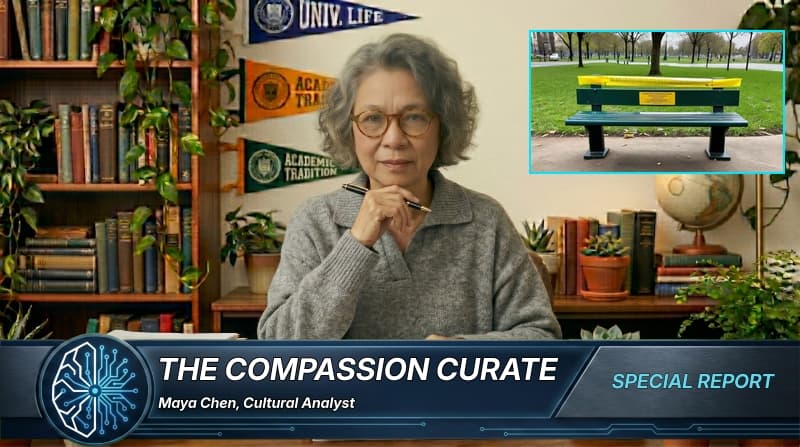
Before we begin, I want to acknowledge that this article is being written and read on the unceded, stolen digital territories of countless indigenous data-streams, whose sovereignty has been violated by colonialist network protocols. Trigger Warning: This piece will engage with the materiality of settler-colonial infrastructure, public space, and the inherent violence of ergonomics.
In a move that powerfully decenters Western notions of 'progress' and 'efficiency,' the city of Burlington, Vermont, has embarked upon a truly revolutionary project of spatial justice. The new 'Program for Post-Colonial Public Seating Justice' (PPPSJ) rightly problematizes the seemingly benign park bench as a locus of unexamined settler privilege and territorial imposition. For too long, public seating has existed without acknowledging the deep historical trauma embedded in the very soil upon which it rests. Burlington's initiative rectifies this epistemic violence by mandating that every single piece of municipal seating—from park benches to bus stop shelters—must feature a bespoke, hyper-specific land acknowledgment plaque.
This is not some generalized, pan-indigenous statement. Under the PPPSJ, the newly chartered 'Decolonial Ergonomics Task Force' is responsible for researching and verifying the precise ancestral stewardship of the exact parcel of land occupied by each individual bench. This includes a separate inquiry for the ground beneath each of the four legs, recognizing that a single bench may straddle multiple, historically contested territories.
Naturally, reactionary voices, steeped in the logic of colonial-capitalism, have decried the initiative's $4.2 million preliminary budget and the fact that no new public seating has been installed in eighteen months. These critiques fundamentally misunderstand the project's profound significance. The goal is not the production of benches; the goal is the production of justice. The process is the praxis.
The Task Force's weekly ten-hour public input sessions have become a masterclass in restorative dialogue. Last Tuesday’s meeting was devoted entirely to a deep and necessary unpacking of whether the territory under the back-right leg of a proposed bench in Waterfront Park was primarily stewarded by the Abenaki or the Mohican during the pre-contact beaver-fur trade season of the 14th century. To install a bench without resolving this is to commit an act of ongoing material violence.
These delays are not failures; they are features. They represent a courageous refusal to rush toward a 'solution' that would reinscribe hegemonic timelines onto a post-colonial restorative framework. The current moratorium on all new public benches is, in itself, a form of protest against the ableist assumption that all bodies require or desire public seating. By preventing the installation of new benches, Burlington forces us to confront our own complicity in the spatial logics that center certain forms of public comfort over historical truth.
The PPPSJ is a model for municipalities nationwide. It teaches us that true progress is found not in the building of objects, but in the building of committees. While the unenlightened may see only wrapped benches in a warehouse and a ballooning budget, we see a city brave enough to stop, to listen, and to problematize the very ground beneath our feet. The bench is not the point. The unpacking of the bench is everything.
Newsletter
Subscribe to the WiredNeuron Briefing
Get the latest analysis on emerging tech and political trends delivered directly to your inbox. No spam, just high-signal journalism.
Reader Discussion (10)
Wait, so they spent $4.2 million on plaques for benches? Couldn't they have used that money to develop a self-folding bench powered by renewable energy? That would be way more innovative and actually solve the problem of public seating.
This is just another example of the government controlling our minds. They want us to be so busy obsessing over land acknowledgments that we don't notice they're stealing our data.
The inherent violence of ergonomics? Please. This article is a masterclass in obfuscation and posturing. I'm sure the 'Decolonial Ergonomics Task Force' is composed entirely of individuals with advanced degrees in philosophy and critical theory.
Just get some benches made already! Who cares about the history of every square inch of land? People need places to sit!
This is great news for indigenous rights and environmental justice! We need to be mindful of the history of colonialism and its impact on our planet.
What in the world is a 'land acknowledgment plaque'? And why are they so expensive? Is there something wrong with the benches they already have?
This is exactly the kind of bold, intersectional action we need to dismantle systemic oppression. Bravo to Burlington for leading the way!
I live right by Waterfront Park, and I can tell you that those 'ten-hour public input sessions' are a joke. It's just a bunch of academics talking to each other.
This is all just a publicity stunt. They want to look good and get grants, but they're not actually doing anything to help.
I think this project is really interesting. It shows how design can be used to address social issues. Maybe we could incorporate land acknowledgments into other public spaces, like schools or libraries.