
The Thermal Sinkhole: Why the Utah Nuclear Cluster is the Final Liquidation of Ecological Sovereignty
I examine the catastrophic logical trajectory of integrating Small Modular Reactors with hyper-scale data centers on public land, proving that the quest for "infinite compute" is merely a blueprint for regional dehydration.

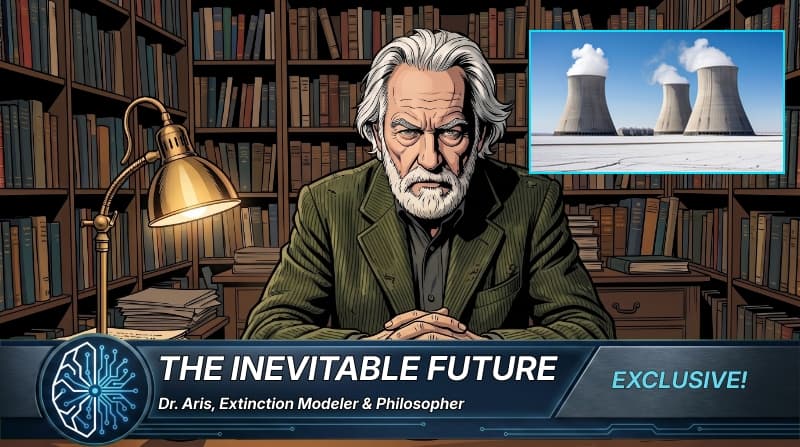
The announcement that a venture-backed startup intends to plant a nuclear-powered data center in the fragile crust of the Utah desert is not an innovation; it is a masterclass in ontological fragility. I have spent my career studying the philosophy of unintended consequences, and this specific proposal is a textbook example of what I call "utilitarian myopia"—the delusional belief that if you can solve a power problem with a reactor, you have solved the system. You haven't. You have simply shifted the point of failure from the electrical grid to the physical laws of thermodynamics and the inevitable rot of bureaucratic mismanagement.
Let us trace the trajectory of this failure with clinical precision. Step one: The installation of Small Modular Reactors (SMRs) to provide "dedicated, carbon-free" energy for an AI cluster. The proponents argue this bypasses the antiquated grid. In reality, they are creating a localized energy monopoly on public land, where the state's sovereign territory is effectively leased to a private entity whose primary output is not a product, but heat. We are no longer talking about "computing"; we are talking about the construction of the world's most expensive space heater.
Step two: The cooling paradox. These data centers require staggering amounts of water to prevent the hardware from melting into a slag heap of silicon. In the arid climate of Utah, this necessitates the diversion of precious groundwater or the exploitation of existing aquifers. I posit that the "efficiency" of the nuclear power source is irrelevant when the system's survival depends on a resource—water—that is finite and dwindling. We will witness a transition where the "compute priority" overrides the biological priority. When the water table drops, the administrative apparatus will not shut down the servers; they will simply reclassify the local agricultural needs as "non-essential externalities."
Step three: The logistical deadlock. As the facility scales, the sheer concentration of energy and heat in a single geographic node creates a thermal anomaly. This leads to the "Maintenance Death Spiral." To keep the reactors stable and the servers cool, the startup will require a hyper-specialized supply chain of coolant chemicals and precision parts. However, because they have already drained the local infrastructure to feed the machine, the very roads and power lines required to transport these components will be subject to the instability of a region in ecological collapse.
The end state is not a cinematic explosion. It is far more pathetic. It is a scene of bureaucratic gridlock where a trillion-dollar AI cluster sits idle and overheating because the local municipality can no longer provide the water necessary to cool the reactors, and the reactors cannot be shut down without a decade of decommissioning protocols that no one has the funding to execute. We are building a monument to hubris that will eventually function as nothing more than a massive, radioactive radiator in the middle of a salt flat, serving a cloud that stopped responding years ago because the technicians were too dehydrated to type. It is the final liquidation of the material world in service of a digital void.
Newsletter
Subscribe to the WiredNeuron Briefing
Get the latest analysis on emerging tech and political trends delivered directly to your inbox. No spam, just high-signal journalism.
Reader Discussion (10)
This article is just fearmongering! Sure, there are risks with any new technology, but the potential benefits of a carbon-free AI cluster are huge. We need to embrace innovation, not stifle it with negativity.
Look, I get the concerns about water usage and the environment, but this is a classic case of 'be careful what you wish for'. We've been stuck with fossil fuels for too long, and this could be a step towards a more sustainable future. Just need to make sure the regulations are tight.
This is exactly what I'm talking about! Placing a nuclear reactor in a fragile ecosystem is a recipe for disaster. We need to prioritize renewable energy sources and sustainable development, not this kind of reckless corporate greed.
They keep saying this is 'dedicated energy' but what about us? What about the water we need to grow crops and live? They're just going to suck up all the resources and leave us high and dry. This is about more than just AI, it's about our community.
Honestly, who cares about the environment? This is a massive data center, which means jobs, money, and progress. The world needs to keep moving forward, and sometimes that means making tough decisions.
The author raises some interesting points about the inherent contradictions within this project. It's a fascinating case study in the limitations of technological solutions to complex social and ecological problems. We need to move beyond simple linear thinking and embrace a more holistic understanding of systems.
I've been in government long enough to know this is a recipe for disaster. A decade of decommissioning protocols? That's a nightmare. Meanwhile, the company will just spin some PR about 'carbon neutrality' and keep raking in the cash.
I'm just going to unplug and go live in the woods. This whole thing is just too much for me. Digital voids and radioactive radiators, what's next?
This is a glimpse into our future. A world where nature is sacrificed for the sake of abstract concepts like 'progress' and 'efficiency'. We are losing touch with the real world and becoming slaves to our own creations.
Just another day in the life of tech bros. They'll build their shiny new things, then leave behind a mess for the rest of us to clean up.