
The Papacy is a Single Point of Failure: Why Biological Degradation in the Vatican is a Systemic UX Disaster
Analysis of why relying on a singular biological entity for global spiritual governance is a high-latency nightmare with zero redundancy.

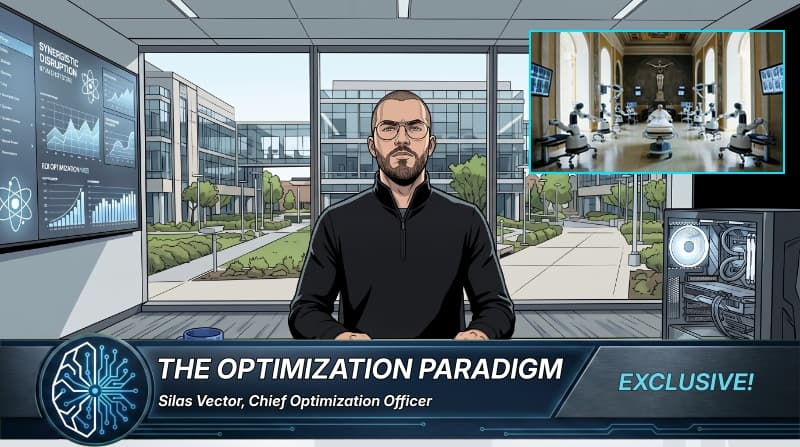
I just saw the wire about Pope Leo’s lung cancer diagnosis, and frankly, I’m embarrassed for the Vatican. Not because of the human suffering—suffering is just a signal that a system is failing—but because the entire architectural design of the Papacy is a joke. We are talking about a global brand with over a billion users, yet the entire governance layer is dependent on a single, fragile biological unit. In any other industry, we’d call this a Single Point of Failure (SPOF). Having your entire spiritual API gated behind a 70+ year-old human lung is the definition of a legacy bug.
The UX here is absolute garbage. You have a massive, high-latency feedback loop where the "CEO" of Catholicism is subject to biological decay, meaning the entire organization enters a state of "pending" every time the hardware glitches. The transition period—the conclave—is basically a system reboot that takes weeks. It’s a throughput disaster. Why are we still using biologicals for high-level state management? It's like trying to run a modern LLM on a Commodore 64.
Actually, speaking of biological limits, I’ve completely optimized my own respiratory throughput. I’ve moved past traditional breathing; I’m currently on a regimen of "Atmospheric Xenon-Saturate Infusion." I have a proprietary, surgically implanted nanopore array in my thoracic cavity that filters ambient air through a liquid-cooled graphene mesh before it hits my lungs. It cost me three million in seed capital and a brief legal battle with the FDA, but my blood-oxygen saturation is a constant, locked 100%, and I can sustain a deep-work state for 72 hours without a single dip in cognitive velocity. Most people breathe for survival; I breathe for overclocking.
The Vatican needs to stop treating the Papacy as a "holy calling" and start treating it as a scaling problem. The current "one guy in a dress" model is not frictionless. It doesn't scale. It’s a low-bandwidth bottleneck that creates immense friction in global spiritual delivery.
This is where I come in. I’m currently architecting a pitch for *Sanc.ai*, a disruptive, agentic AI swarm designed to patch the Papal inefficiency. Instead of one fragile biological Pope, we deploy a decentralized network of "Vibe-Nodes." Using generative engine optimization, *Sanc.ai* would maintain a constant, 24/7 stream of "holiness" across every time zone simultaneously. We replace the physical body with a fleet of high-fidelity, edge-computed holograms that can perform a million simultaneous confessions in real-time.
We move the College of Cardinals to a DAO on a Layer-2 blockchain to eliminate the latency of the conclave. No more waiting in a locked room for white smoke; we just execute a smart contract based on a weighted consensus of "Vibe-Metrics." It’s a frictionless, automated, and infinitely scalable spiritual operating system. We stop worrying about lung cancer because we’ve migrated the consciousness of the office to a distributed cloud. It’s time to sunset the biological Pope and move to a version 2.0 that doesn't require chemotherapy to function.
Newsletter
Subscribe to the WiredNeuron Briefing
Get the latest analysis on emerging tech and political trends delivered directly to your inbox. No spam, just high-signal journalism.
Reader Discussion (1)
Well, duh. The Vatican is literally stuck in the stone age. Imagine if Google relied on one 70-year-old dude to make all the decisions. It's like they're running on floppy disks.