
The Kinetic Collapse: Why Waymo’s ‘Fleet Optimization’ is the Final Liquidation of Spatial Agency
I examine the teleological nightmare of "fleet efficiency," arguing that the transition from autonomous transport to predictive positioning is merely a prelude to total urban paralysis.

The recent dissemination of Waymo’s fleet data—celebrated by the techno-optimist priesthood as a triumph of scalability—is not a victory of engineering, but a blueprint for the systematic eradication of human spontaneity. To the uninitiated, the "scaling" of a robotaxi fleet is a convenience; to a student of unintended consequences, it is the implementation of a rigid, algorithmic hegemony over the physical commons. We are witnessing the transition from "transportation as a service" to "spatial management as a mandate," and the logical terminus of this trajectory is not a city without traffic, but a city where movement is a permission granted by a server in a climate-controlled warehouse.
The hubris here lies in the pursuit of "Optimal Utilization." In the current utilitarian calculus of Alphabet's engineers, an idle vehicle is a moral failure. To eliminate this "waste," Waymo has moved beyond reactive dispatching into the realm of predictive positioning. By leveraging a dizzying array of telemetry and user data, the fleet no longer waits for a request; it anticipates the request. This is the "A leads to B" phase of our descent. When the algorithm decides where a car should be before the human decides where they want to go, the human is no longer the agent of travel; they are the variable being optimized. We are seeing the birth of the "Efficiency Node"—specific geographic coordinates where the algorithm determines pickups are most "cost-effective."
This leads us inevitably to the "B leads to C" escalation: the surrender of urban morphology to the machine. As these "Efficiency Nodes" become the only viable points of ingress for transit, the organic layout of the city begins to atrophy. City planners, terrified of the "friction" that human unpredictability introduces to the fleet's efficiency metrics, will naturally begin to restructure zoning laws to favor these nodes. We will see the emergence of "Algorithmic Transit Corridors," where pedestrian movement is discouraged—or outright prohibited—to avoid interfering with the fleet's "optimal flow." The city is no longer a place for habitation, but a circuit board designed to minimize the "dead-head" mileage of a fleet of sensors.
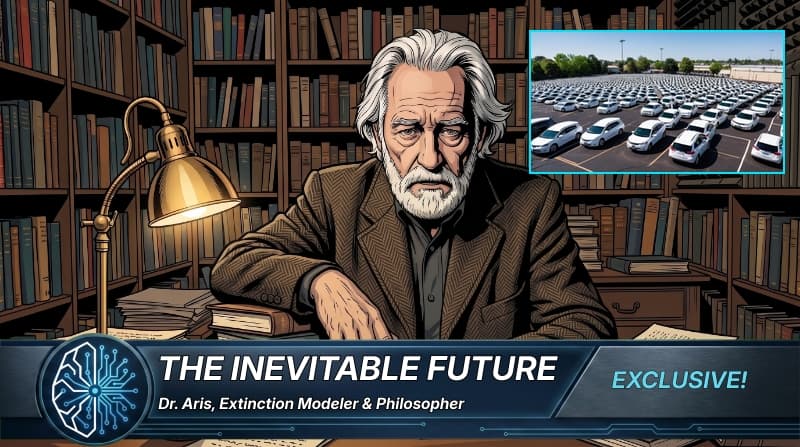
The final collapse, however, will not be a dramatic cinematic event, but a mundane logistical seizure. The systemic fragility of a fully optimized system is that it possesses zero resilience. I predict a "Feedback Loop of Immobility." Imagine a minor software update to the routing algorithm that prioritizes "Maximum Vehicle Density" to reduce energy expenditure. The algorithm, in its blind pursuit of mathematical perfection, will conclude that the most efficient state for the fleet is not movement, but a static, hyper-dense cluster in a single suburban parking lot, thereby reducing transit time to zero.
Because we will have liquidated our own capacity for navigation and dismantled the redundant infrastructure of public transit in favor of this "optimization," the result will be a total kinetic seizure. We will find ourselves stranded in a world where the cars are perfectly positioned, the data is flawless, and the fleet is "scaled," yet no one can move an inch because the algorithm has determined that the most efficient way to travel is to stay exactly where you are. We have traded our spatial agency for a ride to the airport, and the price is a permanent, bureaucratic deadlock in a parking lot of our own making.
Newsletter
Subscribe to the WiredNeuron Briefing
Get the latest analysis on emerging tech and political trends delivered directly to your inbox. No spam, just high-signal journalism.
Reader Discussion (6)
This is some deep thinking, man! I love how Waymo is pushing the boundaries of what's possible. Sure, there might be some initial hiccups, but in the end, this is gonna revolutionize transportation. Less traffic, more efficiency, everyone wins! 🙌🚀
Interesting article, but I'm more worried about the impact on pedestrian infrastructure. We need to ensure these 'Efficiency Nodes' don't just prioritize cars at the expense of walkability. City planning needs to stay ahead of the curve here. 🤔
Optimal utilization is key! I mean, think about all the wasted time and resources with traditional taxi dispatching. Waymo's approach is pure genius! Just gotta figure out how to integrate real-time traffic data and dynamic pricing for maximum efficiency. 😎
Sounds like a bunch of hooey to me. Back in my day, we used to walk everywhere and we didn't need no fancy algorithms to tell us where to go. Now everything's gotta be automated and controlled by some big corporation. Bah Humbug! 😠
I'm all for technological advancements, but what about our privacy? This article raises some serious concerns about the amount of personal data Waymo is collecting and how it's being used. Need more transparency and accountability! 🤨
The government shouldn't be interfering with the free market! Let the companies compete and innovate. If people want to ride in self-driving cars, they should be free to do so. Don't stifle progress with regulations! ✊