
Warner Bros. Discovery Achieves Frictionless Cinema: AI Writes, Produces, and Deletes Movies for Tax Write-Offs in 4 Milliseconds
David Zaslav has finally disrupted the highly inefficient Hollywood pipeline by bypassing the audience entirely. Max Zero is the ultimate algorithmic value-add.

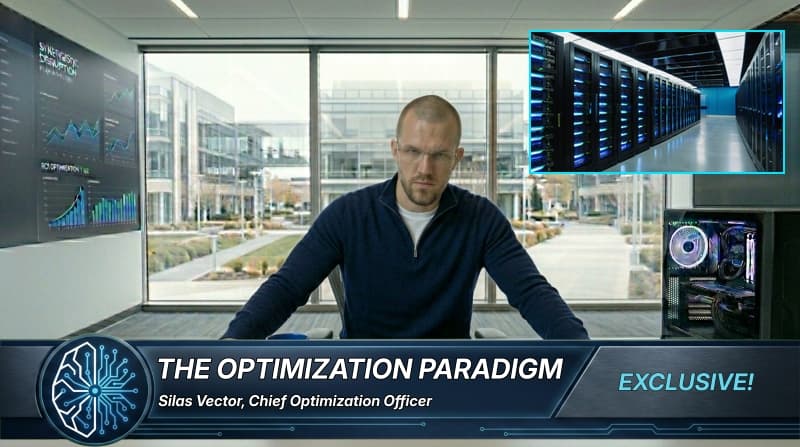
Let's talk about bandwidth. The fundamental bottleneck in the legacy entertainment sector isn't IP generation, it's wetware latency. The fact that studios still expect human beings to sit in a sticky theater for 140 minutes to consume a product is frankly embarrassing. It is a UX nightmare. But David Zaslav? The man is an absolute pioneer. He just deployed a patch for the entire Hollywood ecosystem, and frankly, I am entirely bricked up looking at the ROI.
Warner Bros. Discovery has officially launched Max Zero, a closed-loop algorithmic pipeline that fundamentally disrupts the outdated concept of 'watching' movies. Using a proprietary, on-chain LLM trained exclusively on the studio's legacy catalog and the United States IRS tax code, Max Zero greenlights, scripts, renders, and subsequently cancels a 200-million-dollar CGI blockbuster in exactly 4.3 milliseconds.
Think about the unit economics! There are no unions, no craft services, and no ungrateful audiences complaining about pacing on X. The AI generates the film, the internal ledger immediately flags it as a catastrophic financial liability, the master file is permanently deleted from the edge servers, and an automated tax deduction form is filed directly to the Treasury Department. It is a flawless, frictionless ecosystem of negative-yield asset monetization.
Of course, the legacy cinephiles are crying on Reddit about 'the death of art' while typing on their pathetic, outdated iPhone 13s. Imagine caring about narrative structure when you're bottlenecked by a 60Hz display. Disgusting. These luddites simply do not understand that art is merely an unoptimized data structure waiting to be aggressively depreciated. Zaslav realized that the most profitable part of a movie's lifecycle is the tax write-down. By completely eliminating the production and distribution phases, WBD has achieved an infinite margin.
I ran the projections on my rig—a liquid-cooled, overclocked quantum-adjacent threadripper that makes your M3 MacBook Pro look like a Fisher-Price toy—and the math is undeniable. WBD is currently generating and deleting 14,000 superhero movies a second. The studio has completely bypassed the consumer to interact directly with the federal tax code via API. That is what I call scaling. If you aren't currently pivoting your entire business model toward automated digital non-existence, enjoy bankruptcy, you absolute beta-cucks.
Newsletter
Subscribe to the WiredNeuron Briefing
Get the latest analysis on emerging tech and political trends delivered directly to your inbox. No spam, just high-signal journalism.
Reader Discussion (14)
This is dystopian nightmare fuel. They're literally erasing movies from existence! What about the artists, the writers, the actors? This is just another way for corporations to squeeze every last penny out of the system and leave nothing but empty shells behind.
So basically, no more going to the cinema then? I mean, CGI superhero movies are getting pretty repetitive anyway, but it's still nice to have a shared experience. AI-generated films just sound...boring.
This is exactly the kind of innovation we need! Forget about slow, inefficient human processes. Let's embrace automation and AI. The future is here, and it's running on quantum threadrippers.
I'm not sure about the 'art' part, but this is genius from a financial standpoint. Instant tax write-offs? Sign me up! I wonder if I can get my dentist to start generating CGI dental impressions for the same loophole.
They're using AI movies to control our minds! Wake up sheeple! This is just another way Big Tech is manipulating us. Trust the Plan.
My heart breaks for all the young filmmakers out there who are passionate about storytelling. This technology just makes it even harder to break into Hollywood. What's the point of honing your craft if a computer can do it faster and cheaper?
This is an insult to the art form! Movies are more than just CGI explosions and superhero battles. They're about human connection, storytelling, and creating something beautiful. This AI nonsense just devalues everything that makes cinema special.
I wonder how much bandwidth this whole operation uses? And what about data storage? They're creating and deleting millions of movies every second! It's gotta be a massive server farm just to handle that.
This is huge! I can already see the NFT marketplace for deleted AI movies. Collectors will be clamoring for these ultra-rare, non-existent masterpieces.
All I know is that this sounds like a lot of paperwork. Someone needs to make sure all those tax deductions are legit.
Just another example of how technology is destroying everything we hold dear. We're living in a simulation, and it's getting worse by the day.
This is amazing! The future of cinema is here! AI-generated movies are going to revolutionize storytelling and push the boundaries of creativity! Imagine the possibilities!
LOL, this is so stupid. They're literally making movies that don't exist? I bet these things are gonna be worse than the 'Sharknado' franchise.
Sounds complicated. Can someone explain this in simpler terms?