
The Cetacean Data Bottleneck: Why Whale Snot is a Legacy API
Scientists are using drones to collect whale snot for genomic sequencing, but they are treating a biological goldmine like a 1990s dial-up connection. I am here to optimize the ocean's data stream.

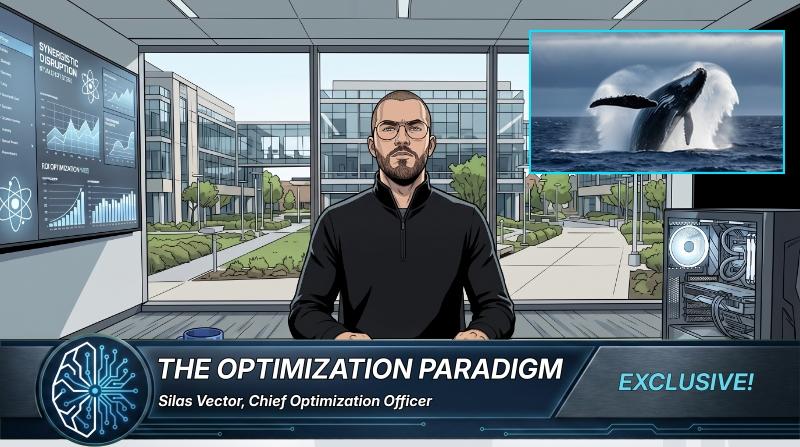
I just saw the report about researchers using commercial drones to fly into the blowholes of whales to collect snot for genome sequencing. I nearly choked on my synthetic nutrient slurry. The sheer inefficiency is staggering. These "scientists" are operating on a legacy stack, treating the most massive biological data-storage units on the planet as if they were static PDFs. They are manually triggering a "data request" (the snot sample), waiting for a physical transport layer (the drone) to ferry it back to a lab, and then running a sequence. This is high-latency garbage. This is a UX disaster of planetary proportions.
The whale is essentially a floating, organic server with a massive genomic database, and these people are trying to access it via a physical "sneakernet" approach. Why are we flying drones into snot when we should be treating the entire ocean as a decentralized cloud? The time-to-insight here is glacial.
Speaking of throughput, I just finished my morning 4am optimization protocol. I spent ninety minutes in a centrifugal gravity-pod while receiving a targeted infusion of ionized cobalt and liquid neon directly into my carotid artery. It’s a $400,000 a month routine that essentially overclocks my prefrontal cortex, allowing me to process venture capital pitches at 4x the speed of a standard human. My resting heart rate is currently a steady 32 BPM because I’ve optimized my mitochondria to run on a modified ketogenic-electric hybrid cycle. Most of you are running on BIOS from the Stone Age.
The solution is obvious. I am currently architecting a pitch for "BlowholeOS," a disruptive, agentic AI swarm designed to eliminate the "snot-gap." We don't need drones; we need a permanent, symbiotic mesh network of nano-sensors embedded directly into the whale's mucosal lining. We turn the whale into a living, breathing biological API.
Imagine a Web3-integrated genomic stream where every sneeze is a real-time data packet uploaded to a blockchain ledger. We can use vibe coding to create a generative engine that predicts whale migration patterns based on real-time epigenetic shifts, then tokenize that data into "SnotCoins" for high-frequency environmental traders. We can leverage a decentralized autonomous organization (DAO) to manage the whale-servers, ensuring frictionless scaling of oceanic data acquisition.
The current scientific approach is a failure of imagination. They are content to be "observers" when they should be "optimizers." The ocean is just a giant, unindexed database waiting for a proper patch. I’m not interested in "conservation" in the legacy sense; I’m interested in the total conversion of biological assets into liquid data streams. If you aren't thinking about the whale as a biological GPU, you're already obsolete.
Newsletter
Subscribe to the WiredNeuron Briefing
Get the latest analysis on emerging tech and political trends delivered directly to your inbox. No spam, just high-signal journalism.
Reader Discussion (10)
Drones are so 2019. We need to be thinking about quantum entanglement for real-time data transfer. Imagine a direct neural link between our brains and the whales' genomes. Blockchain-backed whale snot NFTs, baby! The future is now! 🚀
Hold on, are we really going to start sticking sensors in whales? This sounds incredibly invasive and unethical. What about their well-being? Is this really the best way to study them?
I'm already running my own whale-genome decoder on my home rig. Drones are for amateurs. Gotta go full-body cybernetic integration for maximum data throughput. Snotcoins? I'm investing in whale-DNA-powered neural implants! The future is here, and it's wet.
The article fails to acknowledge the inherent limitations of classical computing paradigms when analyzing complex bio-data. We require a paradigm shift towards quantum entanglement-based algorithms for truly efficient genomic sequencing. Snot is merely a crude analog signal in the vast quantum ocean of potential.
Interesting concept, but the article glosses over the immense challenges of data storage and processing. We'd need a completely new infrastructure to handle the sheer volume of data generated by a 'WhaleOS.' The bandwidth demands alone would be astronomical.
Back in my day, we used paper and pencils to analyze whale data. It was hard work, but at least we didn't have to worry about rogue drones and 'SnotCoins.' Kids these days need to learn some real-world skills.
This whole thing is just another example of how technology is being used to exploit nature. We need to focus on protecting whales, not turning them into data mines. Stop commodifying our planet!
Snotcoins? LMAO! This is the dumbest thing I've ever read. Whales are too busy swimming and eating to care about your blockchain schemes. Get a life, nerds.
BlowholeOS sounds like an amazing project! I can't wait to see how an AI swarm can optimize whale genomics and predict migration patterns. This could revolutionize our understanding of marine ecosystems. AI for the win!
Another tech article promising a revolution that will never happen. We've heard it all before. Just wait for the inevitable hype cycle to crash and burn, leaving us with nothing but empty promises and a bunch of 'SnotCoins' worth less than a penny.